Mar 17 2011

The Piedmont City Council should be honored by the  extensive campaigns to win their favor and vote.  Given the great polarization on the issue of whether or not to develop Blair Park, perhaps it is time to allow all citizens of Piedmont to express their preference on this consequential project in the privacy of the voting booth rather than leaving the decision to five people, the members of the City Council. > Click to read more…

Mar 15 2011

Piedmont Civic Association Commentary on the Decision-making Process

The decision on the Blair Park proposal requires careful consideration by the Council as Piedmont’s fiduciaries. Piedmont residents have been unhappy because of  recent debacles costing almost $3 million of City funds.  To date, the Blair Park and Coaches Field proposals have cost the City over $200,000.  And no stable figures have been produced on the fiscal implications of the project for Piedmont taxpayers.

To satisfy the burden of due diligence and fulfill its “fiduciary responsibility” in considering this consequential proposal, the Council must examine all of the costs and independently assess liability risks in a long term plan.  The Council needs to know the risks and the costs before accepting a project in any form.

Piedmont property owners want to be protected from another risky liability situation as occurred in the Piedmont Hills Underground District bailouts, Crest Road collapse, and Hampton-Sea View litigation.

Mar 8 2011

A Letter on the Absence of a Council Vote on Termination of Swim Club Negotiations:

March 7, 2011

Dear Council Members,

The approved minutes of the Feb. 7 Council meeting state that “the Council directed the City Administrator to terminate negotiations with the Piedmont Swim Club regarding the lease of City property at 777 Magnolia Avenue and begin the process for the City to assume pool operation.”

However, there is no record of a resolution or a vote on the issue, which was noticed as an informational item only. > Click to read more…

Mar 6 2011

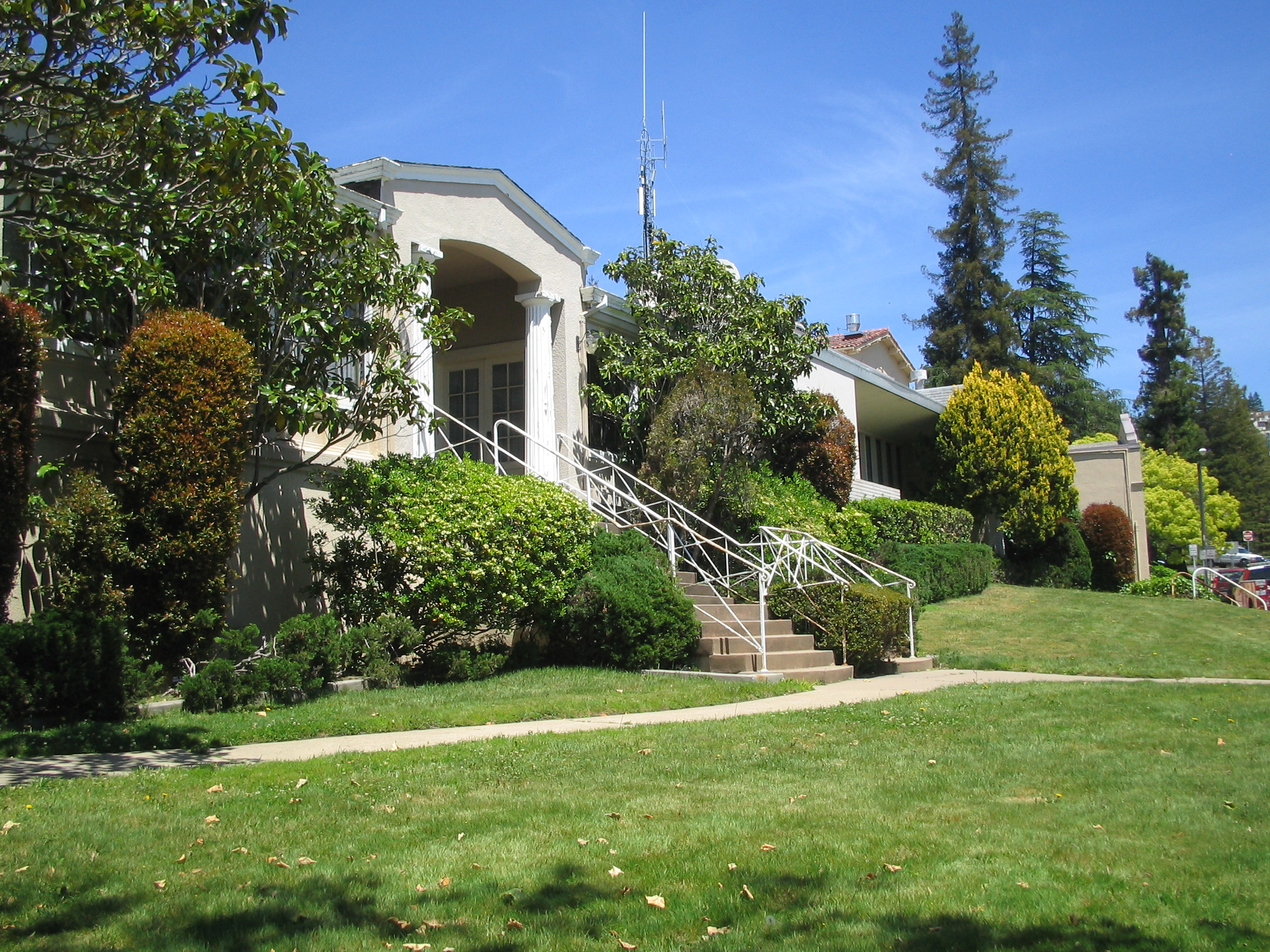
The former Christian Science Church next to Piedmont City Hall at 801 Magnolia is being eyed by a non-profit organization for a variety of cultural events and activities.  The City purchased the property from the church in 2003 but has used it sparingly because of structural and maintenance problems.  In recent years it has fallen into disrepair.

A newly formed organization, Piedmont Center For the Arts, Inc., has offered to make some of the needed repairs in exchange for free use of the property.

Resident Timothy Rood has written a letter to the Council asking for consistent application of lease terms: > Click to read more…

Mar 6 2011

A Letter urging consistent treatment of leases under City policy

Dear City Council Members,

I see that Mr. Grote has recommended you consider a no-rent 10-year lease proposal from a private organization for exclusive use of the City-owned property at 801 Magnolia. > Click to read more…

Mar 5 2011

Over $450,000 of City funds prioritized for undergrounding Moraga and Oakland Avenues have been loaned to, but not repaid by, private undergrounding district homeowners.  The history of how this occurred goes back many years.

The Public Utility Commission requires that PG&E set aside money it receives from utility users in a special 20A fund reserved for public undergrounding projects*.  This is in contrast to 20B and 20C districts which rely on private funding:

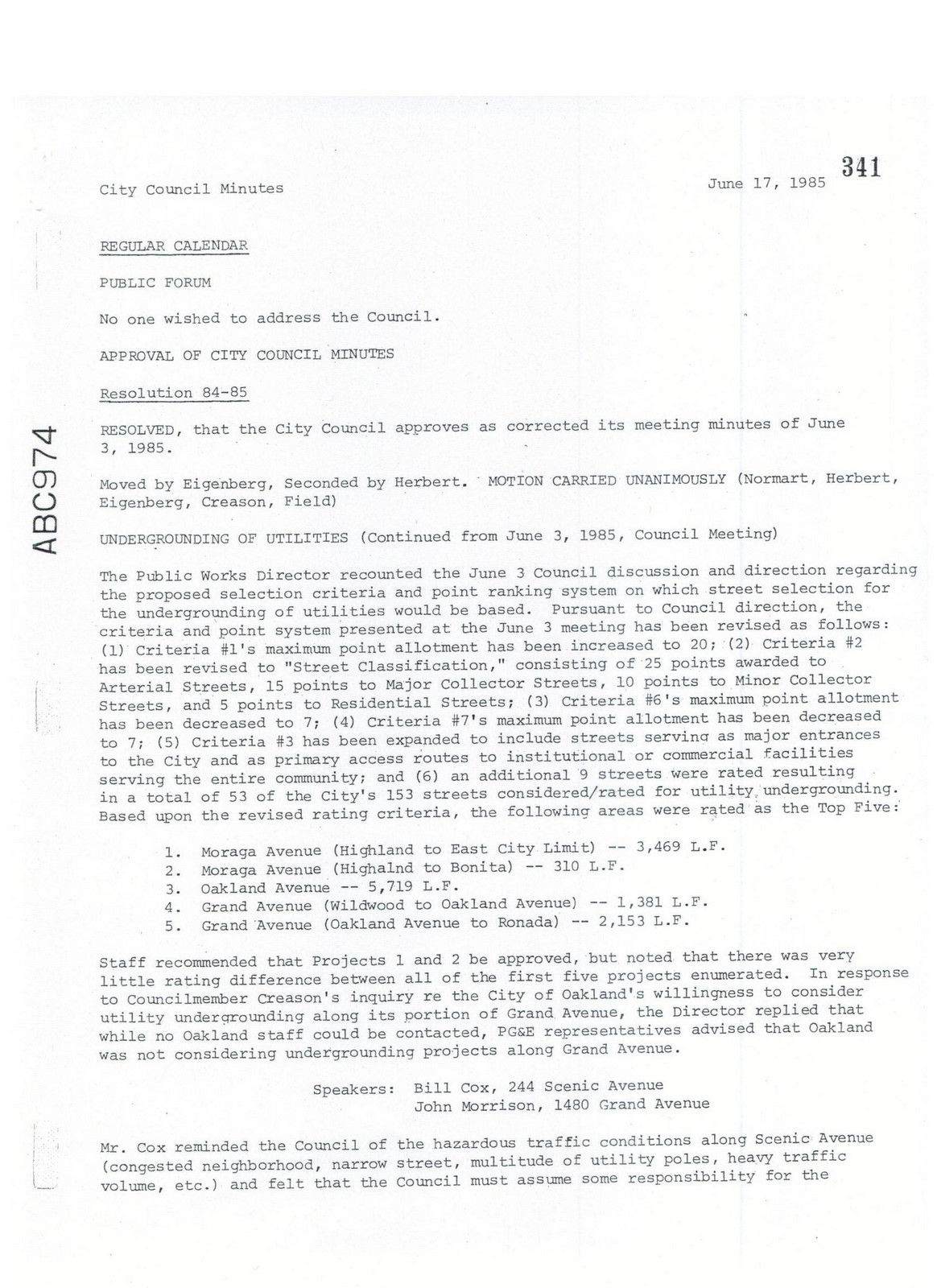
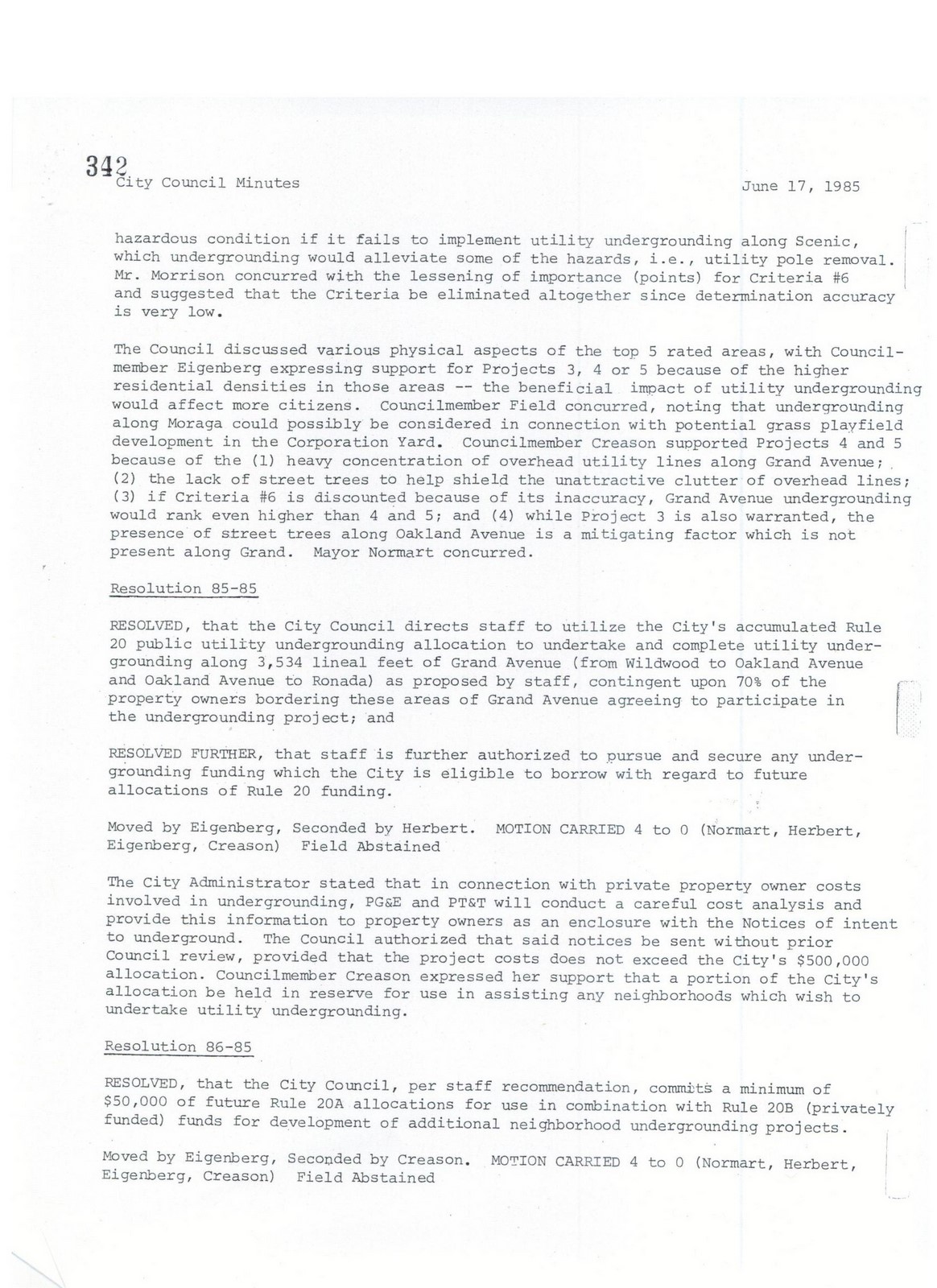
  • 20A Projects use 20A funds to pay for public undergrounding projects. In Piedmont, Moraga, Oakland and Grand Avenues, major corridors, were prioritized for the City’s 20A funds after a comprehensive study conducted by staff. (See Resolution 85-85, p. 1, p. 2, p. 3.)  Grand Avenue undergrounding was completed using 20A funds.
  • 20B Projects use money from property owners self-selecting themselves. City Council approval of the district allows a special assessment district to be formed and bonds issued; construction is performed under the management of the City.  Current 20B agreements between the City and homeowners open the City General Fund to invasion for costs not originally a part of the City’s agreements with property owners who desired the undergrounding project.  The City may bear the risk of cost overruns beyond contingency funds and Acts of God. (Chiang report, p. 6 and 13.)
  • 20C Projects use money solely from property owners self-selecting themselves who work directly with PG&E to manage the undergrounding project.  The property owners pay all expenses incurred and the City plays no management role in these projects.  There is no risk to the City.

Using 20A public funds for the benefit of private districts

Undergrounding proponents have urged the City to make 20A public funding available to 20B private district as seed money since 2003.  (See p. 5-7 and Source Materials below).  At a 2-3-03 City Council meeting the City Administrator advised there were too few 20A monies to fund the undergrounding of any properties except those owned by the City and School District.  (p. 4)  However, the Council supported their use, “agreeing that the likelihood the City will ever use Rule 20A funds to finance utility undergrounding along Oakland Avenue is remote.”  (5-5-03, p. 7.)

In October, 2003 the Council considered and authorized $25,000 to Central Piedmont when proponents ran short of funds.  > Click to read more…

Mar 4 2011

Piedmont Civic Association Commentary on Undergrounding Reports from the Audit Subcommittee and the League of Women Voters


To date, the efforts of the Audit SubCommittee and the League of Women Voters have emphasized contract administration analysis.  Information and analysis of undergrounding concerns provides a valuable shared knowledge base to the Council and residents in their upcoming efforts to undertake substantial revisions to City undergrounding policy.  It is hoped both the Audit Subcommittee and LWV will continue their much appreciated efforts, providing analysis and recommendations to the Council and the community on:

  • The use of public funding to facilitate the creation of  private undergrounding districts
  • The loss of 20A public funds
  • The City’s financial stake in approving Districts
  • The potential or perceived impact of a financial stake on the decision-making process
  • The magnitude of 20B projects in comparison to City revenues and reserves
  • Other  undergrounding options:  20C Districts and city-wide undergrounding
  • Chiang analysis:  Does the City become the  “ultimate insurer” of every 20B undergrounding project?
  • Will immediate knowledge and reporting of cost overruns improve the City’s options?
  • Shifting cost risk from the City to private districts
  • Preventing misunderstandings by Staff and/or Council of the nature of City contracts
  • The extent and appropriate use of informal meetings, without formal public notice, between homeowners and city staff
  • Review of additional aspects of past experience
  • Optimum threshold level of support – review, comparison and a specific recommendation
  • Grounding the report upon the Piedmont City Charter

The use of public funding to facilitate the creation of  private undergrounding districts

Current undergrounding policy prohibits the use of “general funds” for pre-formation expenses.  However, this policy has been interpreted to refer only to the City’s General Fund, and to allow the use of 20A public funds (a separate account containing monies received from PG&E for undergrounding major arterial streets) for the benefit private 20B districts.  Use of these public funds has been authorized as follows:

Mar 4 2011

The following are recommendations and highlights from individual draft reports prepared by Mayor Dean Barbieri, Vice Mayor John Chiang and Judge Ken Kawaichi, the three members of Piedmont’s City Council Audit Subcommittee.  Their separate drafts are scheduled to come together in a final report to the Piedmont City Council which examines  the Piedmont Hills Underground Assessment District problems and provides recommendations for policy changes to preventing future similar problems.  Public input is requested by the Subcommittee prior to its next hearing on March 15.  Email dbarbieri@ci.piedmont.ca.us, jchiang@ci.piedmont.ca.us, kkawaichi@ci.piedmont.ca.us. > Click to read more…

Mar 3 2011

Editors’ Note: This is the League of Women Voters’ Report in its entirety.


League of Women Voters Task Force to Investigate and Report

on Piedmont Hills Undergrounding District

February 22, 2011

Summary of Preliminary Findings

The Piedmont Hills Undergrounding District (the “District”) project (the “Project”) incurred significant construction cost overruns, of which over $2 million was paid by the City out of its general funds in early 2010.  The City Council thereafter appointed a three-person Audit Subcommittee to investigate how and why the overruns had occurred, and now approximately one year later, it has just recently released its members’ preliminary draft reports.

The League of Women Voters (“League”) felt that the events and circumstances raised issues of civic importance to all City voters, and created a volunteer Task Force with the goal of providing an independent investigation and report.  This preliminary report by the Task Force identifies what it believes to be some of the significant problems that led to the unprecedented cost overruns.  Within the next month, the Task Force anticipates providing the Audit Subcommittee with comments on its members’ preliminary draft reports and anticipates participating in the public comment process.  The Task Force may issue a further report if the Audit Subcommittee’s final report has material changes.

Executive Summary

The Task Force was formed by the League in early 2010.  The magnitude of the cost overruns raised issues regarding the City’s ability to manage and administer major contracts.  Potential members for the Task Force were interviewed by the League, and the following long-time Piedmont residents were selected: Alex Gunst, Mary Heller, Rob Hendrickson, Al Peters, and Kathleen Quenneville.  Task Force members’ backgrounds include construction project management, accounting, city governance, and legal. > Click to read more…

Jan 31 2011

An Editorial from the Piedmont Civic Association

Democracy, according to Webster’s Dictionary, is “government in which supreme power is exercised directly by the people or by their elected representatives.”

The inappropriate comments by Council Member Jeff Wieler referring to one or more citizens as the Taliban has brought out various responses: apologies, forgiveness, attacks, justifications, excuses.  What seems to be missing in many of the responses is an interest in the right and need for citizens to inform their government and their fellow citizens. For a citizen to provide information to an elected body, can this possibly be wrong?  Can it be wrong to suggest future taxes may not be voter approved, given unacceptable governmental decisions?  Isn’t this the role of voters?

Democracy requires the active participation of its citizens.  This activity should not be ridiculed in the press.  It should not lead to intimidation.  Both our town and our country need more people to come forward and be involved.  To shame, belittle and name call undercuts the importance of citizen participation, which is at the core of democracy.

Taxes, land uses, schools, elected officials, governmental processes – all are the responsibility of citizens, and all benefit from citizen interest and involvement.  If voters do not support what their elected officials do, government needs to know this and to welcome participants at meetings to express concerns without being harassed or becoming the target of negative press reports.

In an active, working democracy, every citizen has not just the right – but the necessity – to know what their government is doing.  Every citizen has not just the right – but the obligation – to challenge policies and processes.  Every citizen has not just the right – but the need – to hear the opinions of every other citizen. The deliberative, democratic process benefits from the expression of various points of view rather than just one.  No matter how strongly individuals feel about their positions, the right of everyone to be involved and  for the government to hear a variety of views needs to be not just respected, but protected.

Poor journalism, verbal attacks by elected officials, and disregard for the opinions of others undermine our democracy.

Let’s strengthen democracy in Piedmont by listening to and considering all points of view.  It is our government.