

Jul 21 2015

Property Line Between Early 20th Century Houses Raises Issues for New Owners –

On Monday, July 20, 2015, the City Council heard its first Planning Commission appeal for the year. The appellant was Alice Creason, who lives next door to Seamus and Fernanda Meagher.  The Meaghers’ application for 212 Bonita Avenue called for extensive remodeling of their newly purchased 1908 home owned for 57 years by Herbert and Marjorie Michels.

The application included increasing garage space to accommodate four cars, parking court, additions to the house, landscaping, redesigned frontage fence and gate, and a habitable space over the three car garage.

Most neighbors, including the appellant, thought the improvements to the home would be highly desirable. The garages, parking court, and large new habitable space presented issues for some of the neighbors, particularly Creason, whose privacy was impacted.

At the Planning Commission hearing on June 8 and prior to receiving their approval,  the applicants assured the Commission that their plans would all be on their property.  A week later Creason, relying on the surveyed property line, had fence installers on the job building a property line fence. The applicant physically prevented the fence installation by moving cars and trucks onto Creason’s property.  After which, Creason appealed the Planning Commission decision based on new relevant evidence regarding the property line.

City Attorney Michelle Kenyon advised the Council that they could not consider property line issues.  The applicants’ plans showed the surveyed property line.

After hearing from numerous speakers, the Council acted to deny the appeal, uphold the Commission’s findings, and add a new construction management condition to the approval.  Proposed by Councilmember Tim Rood, an architect and planner by profession, the following was added to the conditions required of the applicant. The following condition is similar to conditions required on other approved projects.

“Neighboring Property Owner Permission –

Should the execution of the project, including the demolition of the existing garage in its entirety, require access onto a neighboring property for demolition or construction, the applicant shall submit prior to the issuance of a building permit the signed written statement from the adjacent property owner granting permission for access onto his or her property for purposes of demolition or construction.  As an alternative to gaining the signed written permission of the adjacent property owners for access to accomplish the demolition of the existing garage, which must be demolished in its entirety, including its walls and footings, the applicant shall include documentation in the construction management plan that clearly identifies and outlines how the applicant can demolish the existing garage including its footings without accessing a neighboring property.”

Councilmember Bob McBain urged a harmonious resolution.

Vice Mayor Jeff Weiler, officiating at the Council meeting in the absence of Mayor Margaret Fujioka, stated, “Where I grew up this is called the opportunity to play, ‘Lets make a deal’.  I would encourage both parties that they each want something from the other party to try to figure out a way to obtain their desire by working with the other side.”
Jul 18 2015

Construction debris and removal dominate Council Agenda on July 20 –

The Piedmont City Council will meet Monday, July 20, beginning  with a Closed Session in the City Hall Conference Room at 7 p.m. for consultation with legal counsel on anticipated litigation. Any action taken will be reported in the following open meeting, expected to begin at 7:30 p.m. The public is invited to attend the public meeting in the Council Chambers at City Hall, 120 Vista Avenue.

Agenda:

A public hearing on an appeal of a Planning Commission approval. Staff Report

Consideration of $339,745 purchase of Motorola radios for Police, Fire Department and Public Safety. Staff Report

Consideration of agreement with Green Halo on reporting of construction debris and removal according to California law regarding recycling.  Staff Report

First reading of City Code amendment on construction debris and removal. California law requires construction waste management plans for new construction or additions costing $50,000 or more. Staff Report

Jul 9 2015

It is outrageous that the California Public Utilities Commission released its plan for changing electricity rates on Wednesday before the July 4th weekend, and approved it on Friday, giving no time for public comment, or even for public awareness of its action.  Current rates which reward energy conservation will be reversed, so low-usage customers will be paying higher rates while high-usage energy wasters will pay lower rates.  This would mean higher bills for about 75% of electricity customers in the coming years, while rate reductions would go to the top 5% of users.  That just ain’t right.

In addition, customers who have installed solar power will pay an additional surcharge “to keep the electric grid running.”  What about California’s goals for clean and sustainable energy?  These rate changes shove in the wrong direction.

Can Governor Brown reverse the CPUC’s bad decision?  Can the Democratic-majority legislature save us from this blunder?  Perhaps yes, if enough angry citizens let them know we aren’t gonna take this any more.

Bruce Joffe, Piedmont Resident

Editors’ Note: Opinions expressed are those of the author.
Jul 5 2015

Mixed Commercial/ Muliple Family Residential development to be presented –

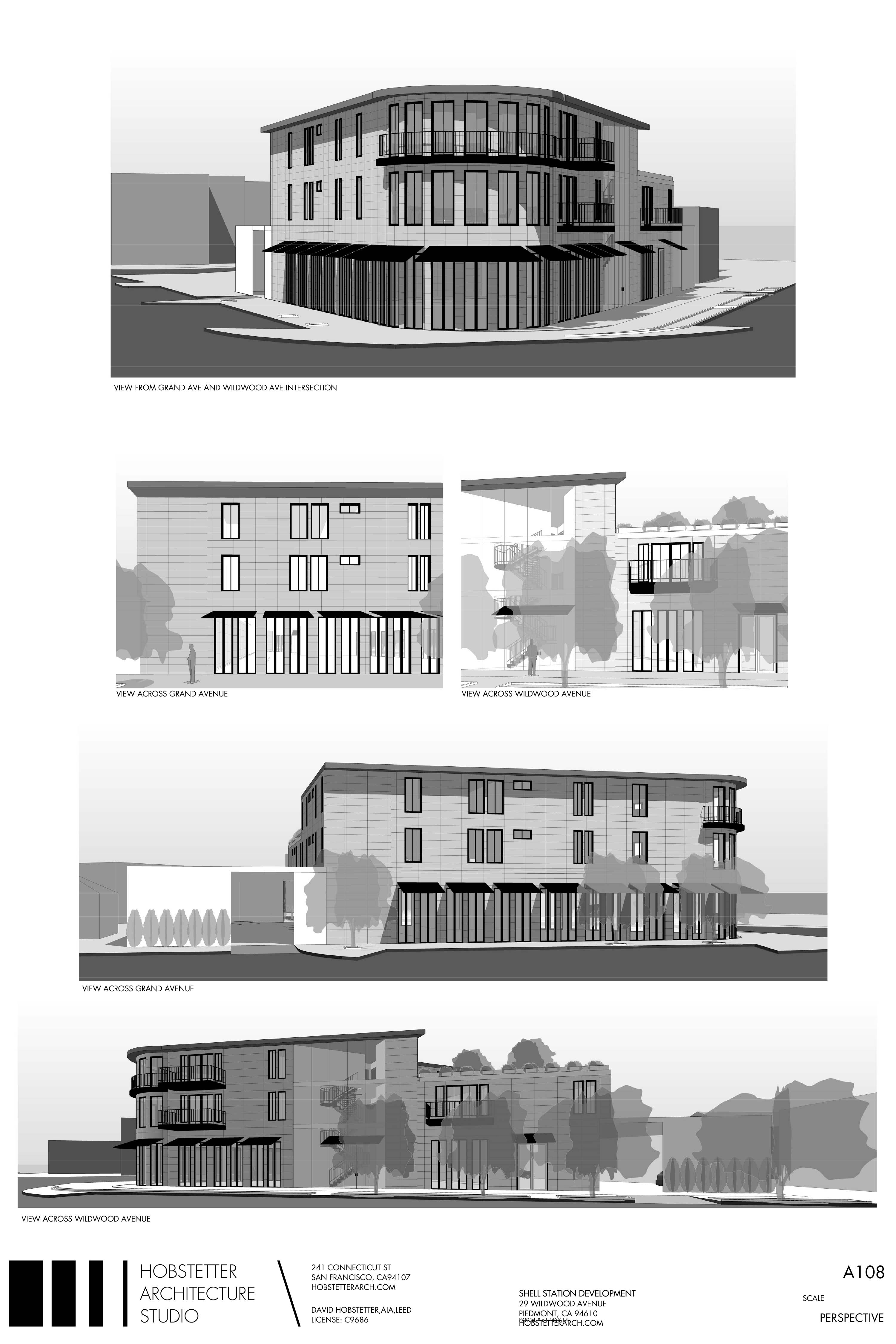
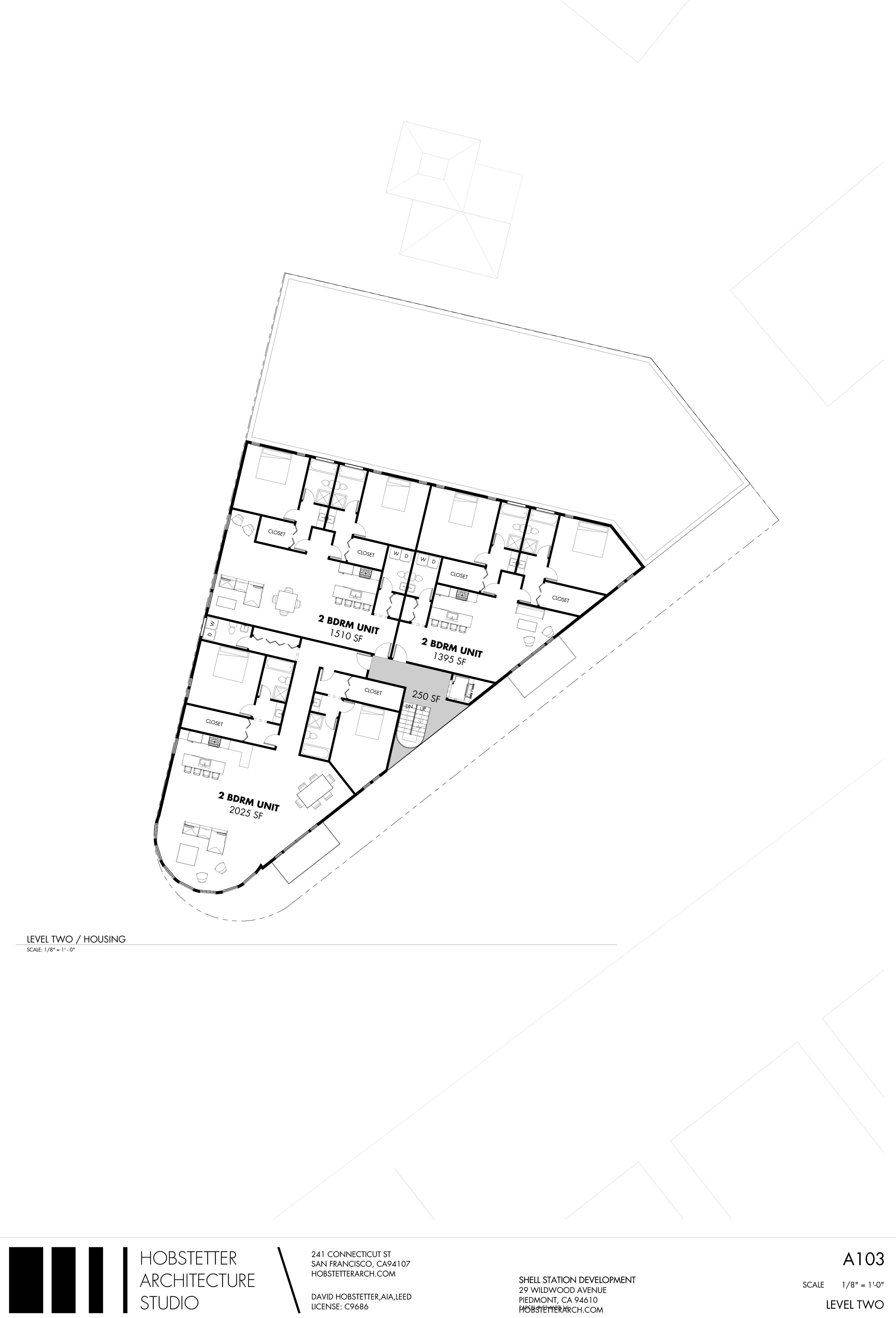
On Monday, July 6 at 5 p.m., the City Council will hold a joint work session meeting with the Planning Commission to learn about a development proposal for 29 Wildwood Avenue from the project team. The site is the long established Shell gas station at the corner of Wildwood and Grand Avenues, owned by City Gateline, LLC. The 10,478 square foot lot is primarily in Piedmont, but 789 square feet are within Oakland. Like the former PG&E site, which was not developed as affordable housing, this site meets the state and ABAG criteria for affordable housing.

29 Wildwood elevations

29 Wildwood elevations


The Shell gas station would be demolished and replaced with a three story mixed use structure featuring retail space on the ground floor and two floors of three two-bedroom residential units on the upper floors. As proposed in concept drawings, staff notes that the project does not meet Piedmont’s parking requirements.

This unique pre-application presentation by a private owner on a planning matter at a joint meeting of the City Council and Planning Commission will not be broadcast or visually recorded. The special session will take place in the Police Department Emergency Operations Center (EOC), 403 Highland Avenue.

29 Wildwood floor plan

29 Wildwood floor plan


The public is invited to be present and comment on the proposed project.

Recent controversy centered on a City Council enacted zoning change allowing multiple family residences in the Commercial zone.  The change eliminated the long standing requirement permitting only commercial uses or single family residential dwellings in the Commercial zone.  The City Charter states zoning changes require Piedmont voter approval.

This is the first multiple family proposal under the new Commercial zoning change.

Jun 11 2015

– Despite Ever Increasing Water Rates, Few Customers Protested. –

Following its June 9 hearing, the Board of Directors of the East Bay Municipal Utility District (EBMUD) unanimously approved new rates and the drought surcharge after receiving only 131 valid written protests from the 381,200 parcel customers. The 8% rate increase takes effect July 1, 2015. EBMUD water rates increased 9.75 %  beginning July 1, 2013, and increased again on July 1, 2014 by 9.5%  as increasing conservation continues to reduce revenue. EBMUD declared a Stage 4 critical drought and set a community-wide goal of 20% water use reduction, 
compared to 2013 water consumption.

At the hearing, residents spoke of their long-standing water conservation habits, expressing worry that there was no further reduction possible.

Stopwaste.org staff members Jeff Becerra and Teresa Eade strongly objected to the EBMUD rebates for replacing lawns with artificial turf at the expense of the environment. Eade detailed the deleterious effects: it off-gases, is hotter than asphalt in the summer and has to be land-filled after its limited life.

San Francisco Sierra Club Water Committee leader Sonia Diermayer, disagreed, “Rebates for replacing lawns are great! My mother and her neighbors in Lafayette have huge lawns that consume so much water.”

Glenda Dugen of Walnut Creek objects to all rebates, indicating that conservation is just common sense and we should all be doing whatever we can.

Former EBMUD Director Helen Burke supported the need for increased rates and the watershed management program that excludes bikes on District lands. She noted the very active efforts of bicycle groups to get access and referred to the many problems and expenses recorded in Marin, after opening water district lands to bicycling.

Several citizens described floods and water damage from a leaking tank of treated water in El Sobrante.

Board of Directors Vice President William Patterson, who represents most of Oakland, urged the staff, “We should go after reimbursement from the State of all the funds we pay for water they have curtailed this year.”

Director Marguerite Young, who represents Piedmont, praised her district, “A whole lot of my district customers are already low water use households.”

DirectorAndy Katz, who represents Albany, Berkeley, Emeryville, El Cerrito, Kensington, and a part of Oakland, added, “We have many customers who are conservers, but we also have customers who use a lot.”

In addition to the rate increases and surcharges, those who do not conserve will be billed penalties. Read about Excessive Use penalties here.

Jun 11 2015

– Attaching Water Trailers to the Budget Bill Bypasses Normal Consideration by Committees and Citizens. –

Three water bills that would affect Piedmonters and other water customers could pass quickly without adequate transparency and citizen awareness, according to East Bay Municipal Utility District (EBMUD) Board of Directors President Frank Mellon.  June 15 is the constitutional deadline for the Legislature to pass the budget, very little time for those trying to stop or modify the language of the proposal.

The Association of California Water Agencies (ACWA) wants to stop the proposed budget trailer bill 825 or significantly change its language. It would authorize the State Water Resources Control Board (SWRCB) to require consolidation of public water systems, overriding local agency procedures, planning and budgets. The California Association of Local Agency Formation Commissions, the California Municipal Utilities Association, the California Special Districts Association, the California State Association of Counties, the League of California Cities and the Rural County Representatives of California are joining ACWA to urge legislators to defeat 825 in this letter.

Passing budget trailer bills that arise suddenly at the end of the fiscal year is an expedited process recommended by Governor Jerry Brown, avoiding policy and fiscal committees’ review.  Mellon calls this fast enactment arbitrary, “We need to see the language and not just push through these bills.”

EBMUD is also opposing trailer bill 807, which would substantially change the funding structure of the SWRCB drinking water program by emergency regulation. “The amount of fees charged to each large water system, such as EBMUD, would not have to be based on actual costs…” according to the EBMUD analysis.  Piedmonters should expect that additional fees charged to EBMUD will be passed on to customers.

EBMUD favors trailer bill 807, which would require new multi-family residential buildings and mixed residential and commercial buildings to install individual water meters for each unit. It would have no impact on all the existing multi-family residential buildings that do not have meters for each unit. EBMUD Ward 4 Director Andy Katz agreed, “submetering leads to conservation” by occupants of multi-family buildings. Katz represents Albany, Berkeley, Emeryville, El Cerrito, Kensington, and a part of Oakland.

Jun 11 2015

Almonds aren’t the only “big gulp” users of California water.

Each almond shipped out of California required one gallon of our water, a crop that has doubled since 2005, and alfalfa grown for animal feed consumes 20% of irrigation water in the state,  much of which is shipped out, as far away as China.

California water is also shipped out in bottles. Nestle’s Pure Life brand and its Arrowhead Mountain Spring Water bottles water come from a spring on the  Morongo Indian Reservation east of Los Angeles in Millard Canyon, California.  As a sovereign nation, the reservation is not under state law.  However, the water leaves the reservation  across the San Bernardino National Forest to reach the bottling plant.  Nestlé Water’s permit expired in 1988. The U.S. Forest Service announced it would reassess the permit.

Nestle’s permit is not the only out of date water permit in national forests in California. The Desert Sun newspaper reported that 616 water extraction permits are past their expiration dates.

Because those permits haven’t been formally renewed in years, the agency largely hasn’t studied how the taking of that water from public lands may be affecting creeks, wildlife and water supplies downstream. Many of the permits listed as being past their expiration dates are for pipelines that siphon off water from wells and springs in national forests. The pipelines run to the tanks of water districts, as well as to cabins, neighborhoods and properties such as cemeteries, lodges and ranches.

Nestlé insists its permit remains in effect, pointing out that it has continued to pay its annual fee of $524 to the National Forest. A spokesman for the the U.S. Forest Service says the application for renewal of the permit has been under consideration since 1988.

Jun 6 2015

– The public hearing will be held Tuesday, June 9, 2015, at 1:15 p.m. in the EBMUD Board Room, 375 11th Street, Oakland. –

If approved, the new rates and the drought surcharge would take effect July 1, 2015. East Bay Municipal Utility District (EBMUD) has declared a Stage 4 critical drought and set a community-wide goal of 20% water use reduction, 
compared to 2013 water consumption.

An 8% rate increase would begin July 1, if approved by the Board following the hearing. EBMUD water rates increased 9.75 percent beginning July 1, 2013, and increased again on July 1, 2014 by 9.5 percent. EBMUD reports most of its customers have cut back their water use significantly, resulting in the need to continue to increase rates to cover fixed costs.

As of April 15, 2015, single family residential customers are expected to limit indoor water consumption to 35 gallons per person per day. This is challenging many customers since the estimated daily water flow per person even with energy flow toilets, faucets and shower heads exceeds the goal without including laundry or the use of a dishwasher:

10 gallons  = 6 flushes of a low flow toilet

10 gallons  = 1 five minute low flow shower

80 gallons = twenty minutes of low flow sink faucet for hand-washing, teeth brushing, cooking and food/pots/dishes rinsing or washing by hand.

Citizens can direct questions to www.ebmud.com for more information related to the proposed fees.  Phone 1-866-403-2683.

Fee increase protests must be in writing and sent to EBMUD  at:

EBMUD, MS 218, PO Box 24055, Oakland, CA 94623-1055.

Marguerite Young is Piedmont’s Ward 3 representative on the EBMUD Board of Directors.

Mandatory outdoor watering rules:

  • Strict limits on frequency: no more than two non-consecutive days per week 
with no runoff.
  • Strict limits on times: only before 9 a.m. or after 6 p.m.
  • No watering allowed within 48 hours of measurable rainfall.
  • No watering of ornamental turf on public street medians allowed.
  • No washing of driveways and sidewalks; except as needed for health and safety.
  • Use only hoses with shutoff nozzles to wash vehicles.
  • Turn off fountains or decorative water features unless the water is recirculated.

Read the proposed new rates and excessive use penalties.

Related articles:

EBMUD Excessive Water Use Penalties Hitting Houses But Not Apartment Buildings

California Drought: Will Piedmont Wells be Managed?

Jun 6 2015

– Single family households face excessive water use penalties but multifamily buildings are exempt.  –

The water conservation rates are focused on “encouraging reduced water use” by single family residences. EBMUD established an Excessive Water Use Ordinance #364-15 on April 28, 2015, effective May 29, 2015, that prohibits excessive use of water. Single-family residential customers who use more than 80 units (59,840 gallons) of water per billing period are subject to a $2 penalty for each unit (or portion of a unit) over the 80 unit threshold.

The excessive water use ordinance will penalize single family households that use 1,000 gallons per day, which is four times the amount of water used by the average single family residential customer. Sophia Skoda, EBMUD Treasury Manager confirmed to the Piedmont Civic Association that multifamily buildings will not be penalized for excessive water use.

Multifamily developments also appear to receive preferential treatment in the fee structure for new water meters. New single family homes pay $16,100 – $304,500 (in region 3-D) for a water meter depending on the EBMUD region of the proposed house and meter size. Multi-family developments pay $9,370 – $32,000 (in region 3-D) per dwelling unit in the project.

EBMUD outreach to discourage wasting of water

On May 14, 2015, EBMUD made 5,065 robocalls to their customers explaining the drought restrictions. This calling program cost $3.846 or $0.027 per call. Residents are encouraged to report the wasting of water to www.ebmud.com/reportwaterwaste .  In May, 2015, 4,000 water wasters were reported and investigated.

Jun 6 2015

– EBMUD’s assigned water use reduction target reflects residents’ conservation patterns –

Every California urban and suburban water district with more than 3,000 customers was given a mandatory water conservation target for its residential customers by the  State Water Resources Control Board (Water Board) beginning June 1 and continuing until February, 2016. Based on each California water district’s Residential Gallons Per Capita Day (R-GPCD), the Water Board assigned residential water use reduction requirements, that range from 8% to 36%. In general, industrial and commercial customers are instructed to reduce water consumption by 25%. Local governments’ water use is limited not by targets, but by prohibitions on various uses, such as watering public street medians and outdoor landscapes.

Understanding R- GPCD

In California Residential Gallons Per Capita Day is the total residential water use billed in a district divided by the residential population. Some water districts are limited to a single urban district which combines commercial, industrial, government, multi-family residential and single residential household customers. The water supplied for shared public open space is not included.

EBMUD is a large, diverse district –

The East Bay Municipal Utility District (EBMUD), Piedmont’s water district, includes a number of communities with different land use profiles. Piedmont is a single family residential community, while Oakland, Berkeley, Emeryville, San Ramon, Walnut Creek and others have significant commercial and industrial customers. EBMUD’s R- GPCD combines lower water consuming households, such as Piedmont, and higher level water users such as Danville, Lafayette, etc among the 1.3 million residents served in Alameda and Contra Costa counties. As a result, EBMUD was assigned a 16% mandatory reduction. In contrast, a very near neighbor, the Contra Costa Water District has a 28% target, reflecting its higher R-GPCD over some months of the past year.

Water districts must also “produce” (make available) less water in 2015 than they produced in 2013 by their assigned target percentage (16% for EBMUD). However, urban water districts that provide water to commercial agriculture may exclude that water from their monthly reported water production. The Water Board established targets for levels that widen as the reductions increase, based on urban water districts R-GPCD of less than 65 to more than 215 in the summer of 2014.

Target Reduction Levels

Urban water suppliers whose residential customers used an average of less than 65 gallons per person per day in July, August & September, 2014 are required to reduce their use by 8% from June 1, 2015 through February, 2016.

Urban water suppliers whose residential customers used an average of: 65- 80 RGPCD will reduce their use by 12%.

Urban water suppliers whose residential customers used an average of: 80 – 95 RGPCD will reduce their use by 16%.  EBMUD’s mandatory reduction

Urban water suppliers whose residential customers used an average of: 95- 110 RGPCD will reduce their use by 20%.

Urban water suppliers whose residential customers used an average of: 110- 130 RGPCD will reduce their use by 24%.

Urban water suppliers whose residential customers used an average of: 130- 170 RGPCD will reduce their use by 28%.

Urban water suppliers whose residential customers used an average of: 170- 215 RGPCD will reduce their use by 32%.

Urban water suppliers whose residential customers used an average of: 215 or more RGPCD will reduce their use by 36%.

Support for Conservation and new Voluntary Restrictions

The Bay Area has generally been supportive of the new restrictions on water use. In April San Jose outlawed home swimming pools and car washing. Santa Cruz imposed a rationing system of 10 units of water a month per house.

Read about Protests of differential treatment

EBMUD Rate Increase Hearing: June 9