
Oct 30 2012

Part 4:   A Close-Up Look at Piedmont School Finances

In March 2012, Superintendent Constance Hubbard brought a 3-year budget plan before the School Board with a $2 million structural deficit: $1 million ongoing shortfall faced as of 2013-14 and $1 million in reserves will be exhausted by June 2013.  As this structural deficit manifests itself in 2013, residents will be voting on the renewal of a school parcel tax(es) in March.

Revenues Threatened

In addition to this initial deficit, a potential revenue issue has also arisen.  The School District budget being developed in early 2012 included $1.5 million in revenues from the State that were threatened with elimination.  State revenues allocated to Piedmont of $1.5 million will be cut automatically from the Piedmont budget if Proposition 30 fails.  (Although some replacement may come from the passage of Proposition 38 or the legislature acting to  restore funds).

Passage of Proposition 30 does not result in any “new funds” for the Piedmont School District because the threatened funds were already included in budget projections.

$2 million expense growth  +  $1.5 million revenue threat = $3.5 million problem

If passage of Proposition 30 or 38 preserve existing PUSD revenue, Piedmont schools must still address the district an unresolved $2 million in personnel expense growth that exceeds existing revenue.

In March 2012, when explaining the Board’s intention to approve a budget that included an ongoing $2 million structural deficit, some Board Members expressed the opinion that this “deficit budget” approach would create less turmoil than making cuts and later restoring them when new revenues (not in the budget) materialized – i.e. increased state or local revenues above existing projections.  The comparative impact of early adjustments if new or existing revenues did not materialize was not discussed at the March meeting. 

In September, at the first 2012 Budget Advisory Committee meeting, Superintendent Hubbard explained that, when developing PUSD budget projections in early 2012, staff had viewed the State threats to reduce existing funding as a political tactic intended to “frighten taxpayers.”  She further noted that, in her experience, contingency plans create discord and injured feelings when discussed before it is certain that adjustments will be required, even if funding is later restored and actual cuts do not occur.

According to Superintendent Hubbard, employee contract negotiations will be re-opened the day after the vote on Proposition 30 and 38 to resolve the District’s $2 million structural deficit –  and a potential total $3.5 million shortfall.  Potential cost reduction options totaling ~$4 million were identified during 2011 contract negotiations to address the district’s structural deficit, but not yet implemented.   And, if Proposition 30 and 38 both fail, the State could take affirmative action to restore state funding before actual revenue losses occur.

During the March 2012 budget discussion, Board Members did not discuss implementing $4 million in remaining potential cost reduction options identified during 2011 contract negotiations to address the district’s structural deficit.  (Action had previously been taken in 2011 to slow the projected growth of expenses by $3 million and raise parcel tax revenues by $1.2 million; additional potential cost reductions of $4 million were not implemented; as a result, a $1 million deficit was not resolved and $1 million of reserves not maintained.) 

The local school parcel tax was raised as an issue,  including the possibility of placing a new parcel tax structure before the voters for approval.  (See PCA article on Board new tax proposals for a permanent parcel tax and an extra “emergency” tax.)   Recently, the Board has asked for public input on a new parcel tax and a possible emergency tax.  changes that could include:

  • A permanent tax or a 6-8-10 term
  • Flat tax with no escalator (not more than $2,088-$3,547 level)
  • Possible escalators (2-3% cap or an inflation index)
  • 2-part tax (a permanent baseline flat base tax and a supplemental tax)
  • “large” supplement if state tax measures fail (on the scale of $3 million Measure E)
  • Exemptions based on age or income
  • Legal restrictions on parcel size-based tax
  • Continuation of Citizens Advisory Committee
  • 4-year renewal

The past 2 Measure B parcel tax measures were structured (for 2006 and 2009) authorized interim annual tax increases by the School Board of up to 5% per year.  Pursuant to this authorization, the Piedmont School Board levied the maximum 5% tax increases 5 times – each year it was permitted to do so – between June 2007 and June 2013.   These annual increases did not require annual written notification mailed to taxpayers.  The Board complied with legal notice requirements by placing the item “parcel tax levy” on its agenda twice prior to an increase:  first to allow discussion and then to vote. The opportunity to increase accountability for annual increases through polls, surveys or an annual public meeting was raised at the October 3, 2012 School Board meeting.

Temporary Emergency Tax Replaced with Ongoing Taxes 

As of 2001 Piedmont school parcel taxes generated $2.5 million or 12% of the budget.  The levy has since tripled and now generates $8.5 million, or about 33% of the school budget.

The current 33% level of support will continue despite the expiration of the emergency Measure E tax.  While the temporary $1 million Measure E levy expired as of June 2012, new Measure B annual 5%  increases are now generating $800,000 more each year.  If a third potential increase is imposed in June 2013, it will bring the total new Measure B funding to over $1.2 million per year.  These funds replace the lost Measure E funding.

Piedmont School Bond assessments (a separate levy) have been growing due to recent School construction and renovation work, and will continue to do so.  (For more details on future bond assessment increases, see How do School Bond assessments fit into the picture.)

Discussions on the amount and structure of the 2013 parcel tax will be occurring at the upcoming School Board meeting on November 14, and the  School District urges public input before or at this meeting.  A decision by the Board is planned for November 28 to place the new school tax measure on the ballot March 5, 2013.  Piedmont residents wishing to provide input on the tax may contact School Board Members by email (below).

The public is also welcomed at District Budget Advisory Committee (BAC) meetings, where discussions on the parcel tax are also anticipated.  (See schedule of BAC meetings.)

Click here to send email all School Board Members


Oct 28 2012

Part 3:   A Close-Up Look at Piedmont School Financial Decisions 2000 to 2011 –

Following Proposition 13, Piedmonters rallied behind the City’s public school district to enact a school parcel tax. Voters rallied once again to triple the Piedmont school parcel tax over 6 years (2006 to 2011) to maintain Piedmont per-student spending.  The Piedmont tax is now $1,000 to $2,500 more than any other school district in Alameda or Contra Costa counties, including Lafayette, Moraga, and Orinda.

Continued growth in the Piedmont school parcel tax has been deemed unsustainable by school leaders.  Local taxpayer funding has grown at an annualized rate of 15% from 2000 to 2011.  On September 16, 2010, Piedmont School Board members “thanked the community for its financial support for education, including the emergency parcel tax, but all agreed that relying on private funding and temporary fixes is not sustainable — a more permanent solution is needed.” (See September 2010 Piedmont Neighborhood News article.)  The Citizens Advisory Committee for the School Parcel Tax (CAC) recognized the need for support will be intense (at p. 6), but states, the “historical rates of increases in parcel taxes cannot be sustained in the future, and that existing levels may already impose unsustainable hardships on fixed-income and low-income taxpayers.”

A District Goal since 2006 has been “to establish a long term financial plan” which would “address annual budget shortfalls”.  (At p. 31-33.)

Today, the district faces a quandary:  a highly effective education for a relatively stable student population based on current financial resources has not yet been achieved, despite this being a District goal since 2006.  (See report at p. 15.)   The District faces a growing gap, which Board Members and CAC members feel cannot be bridged by a continued rapid growth in parcel tax rates. 

Efforts to Match Spending Growth with Revenue Growth

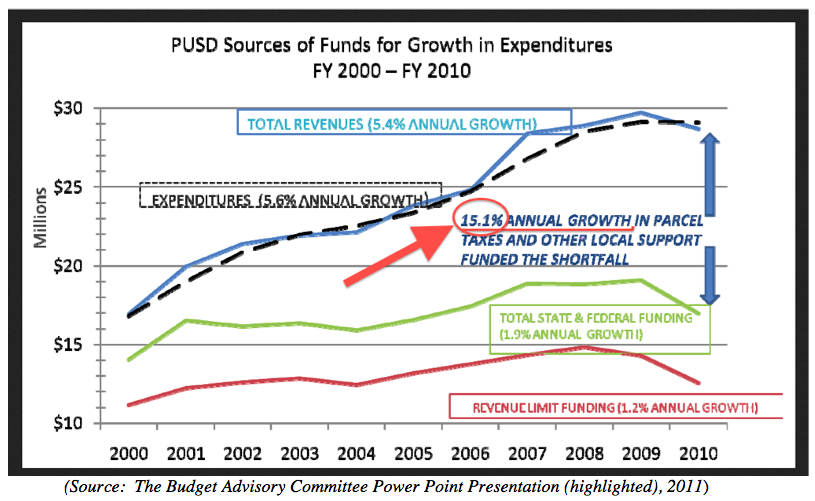
Over the past decade, the District has taken some steps to slow the growth of expenses – but has passed on other opportunities.  Even though state revenues have dropped from $5,837 per student in 2008 to $5,255 in 2012, a drop of 10%, per student expense has increased slightly from $11,074 in 2007 to a projected $11,546 in 2014.*   This is an increase of under 1% per year.  Parcel taxes have increased substantially to fill the loss in state revenue and to fund growing salary and benefit costs.   School Board President Richard Raushenbush noted at a recent School Board meeting on October 24, 2012 that earlier in the decade, district pay was raised substantially, not anticipating State revenue cuts.  Despite State cuts, from 2000 to 2011 total district revenues have increased at an annualized rate of 5.4%, and expenditures at 5.6%.

Overall, PUSD spending almost doubled from 200o to 2010 (increasing $13 million), while state and federal funding increased 1% per year (increasing $5 million).   

In a 2006 report to the School Board, Superintendent Hubbard pointed out,  “Since 2000/1, well over $1 million dollars in operating cost reductions were made.”  (At p. 32.)  This was a 1% reduction in spending growth on expenditures of $170+ million during the period 2000 to 2006. 

In 2006, following voter approval of a parcel tax increase to $1,000+ per parcel, the School Board gave Hubbard a specific District goal:  establish a sustainable “long term financial plan” (at p. 32-33) based on the increased level of local funding.  (For comparison, Moraga, Lafayette and Orinda parcel taxes (including Acalanes Unified School District) were around $500 at the time for K-12 education.  As of  2011, the level of Piedmont funding had climbed to $2,000 to $3,000 higher per student than Lafayette, Moraga, Orinda.)

In 2009, following voter approval of an additional 3-year emergency parcel tax, the District made some budget adjustments, including:

  • For 2009-10, the School District noted overall expenditures of $30 million had been reduced by 2.41% (See report at p. 15), while per-student spending continued to increase (by less than 1% per year).
  • As of June 2009, Cost of Living Adjustments (COLAs) to salaries were frozen, but teachers remained eligible for salary increases based on length of employment and additional education (“Step & Column”); benefit cost increases continued.
  • For 2010-11, rather than reducing on-going expenses, the District balanced its budget through “one-time revenue increases and spending cuts, and dipping into District reserves” according to Superintendent Hubbard.  (See report at p. 15.)

The Outcome of 2011 Employee Contract Negotiations

New employee contracts in June 2011 allowed an opportunity for budget adjustments since salary, benefit, and pension costs for personnel represent about 90% of District spending:

 “In the short term, the District’s single most important opportunity for adaptation is the set of three labor contracts being negotiated between the District and employee groups for the three fiscal years 2011/12 through 2013/14.”  (CAC at p. 1.)

The School Board adopted a policy to fully balance the District budget over the 3 fiscal years ending 2013-14”, providing specific guidance to Hubbard and the other District negotiators. (CAC report at p. 5)

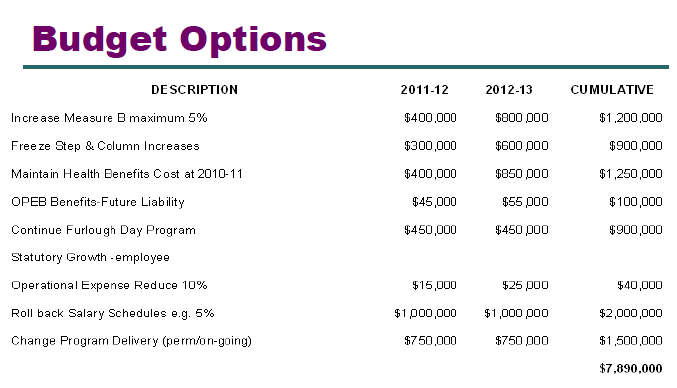
To achieve this goal, Superintendent Hubbard identified specific options capable of generating $8 million in budget adjustments within 2 years.  Most were ongoing rather than one-time adjustments.   Cutting an ongoing expense creates an ongoing budget benefit, while a one-time expense cut affects the budget only one year.   When early opportunities for ongoing adjustments are bypassed, options for saving a particular sum become more difficult.  (Click to enlarge chart showing projected impact on budget.)

Source: Superintendent’s report in agenda packet of September 16, 2010, p. 21. ; see also 9/23/10 Budget Advisory Committee PowerPoint Presentation

Revenue enhancements fully implemented, but not all spending reductions implemented

Revenue enhancement options were fully implemented.  The parcel tax levy has been increased twice by the School Board since 2010, adding the full (compounded) $1.2 million cumulative parcel tax revenue in 2 years.  (See Options Chart.)

Some, but not all, spending reductions were implemented.  A cap was placed on further employee medical benefit increases.  (CAC 2012 report at p. 2.)   Some furlough days were implemented (reducing expenses by reducing instructions days).   Teachers remained eligible for Step and Column salary increases ($300,000 per year cost); COLA salary increases continued to be frozen. Medical retiree benefits, an estimated $4 million unfunded liability, were reduced by $100 per month for retirees.  CalSTRS pension contributions are not on the option list because they are set by the State and cannot be altered.  Of the projected cost reductions identified, about $3 million were implemented and about $4 million were not.

As a result, the next 3-year budget plan Superintendent Hubbard presented the School Board (in March 2012) did not balance.  It projected reserves would be exhausted in year 2 (June 2013) and an ongoing $1 million shortfall was anticipated in year 3 (2013-14) and every year thereafter.  This left the School Board in the position of certifying a budget to the Alameda County Superintendent of Education as “Positive” (i.e. vouching that the district had the ability to pay its bills) based on its ability to lay off 32 teachers in June 2013.  (See here and School Board hearing discussions.)  County authorities were consulted to determine whether the School Board could provide this certification with projections showing a deficit and no reserves (a 3% reserve is normally required by law).  The PUSD received the necessary reassurance.  Appropriate certification of the budget by the School Board is important to avoid a potential State takeover of a school district.

What Lies Ahead

Uncertain State funding has not made the District’s budgeting easy.   State revenue limit funding to Piedmont has decreased from $5,837 per student in 2008 to $5,255 in 2012, for a reduction of $582/student and a cumulative loss of $7 million.  This $7 million loss has been offset by an increase in Piedmont parcel taxes:  a $3 million emergency parcel tax (Measure E) plus increases in the regular (Measure B) parcel tax since 2008.  Local taxpayer funding has increased from 12% in 2000 – to 33% of the district operating budget in 2008 – to 39% as of 2012 to offset the loss of State funds.  Despite the state revenue drop, overall PUSD per-student spending has remained relatively flat, increasing by less than 1% per year since 2008.

Over the past decade, local parcel taxes have covered both loss of state revenues and growth in PUSD personnel costs.  With the approval of the School Board, the PUSD has not built up reserves, in line with the PUSD Superintendent’s “philosophy of spending all the revenue” each year and maintaining 3% reserves.  In contrast, some other districts have built up substantial reserves, e.g. Walnut Creek up to 37%

Previous choices during 2011 contract negotiations made by Superintendent Hubbard and the School Board have left the PUSD with a $1 million ongoing structural deficit and $1 million in missing reserves.  The Piedmont Board of Education states it is “committed to making policy and financial decisions that enable the school district to provide quality educational programs and services to all students of our community.”   Piedmont’s class sizes, classroom support para-educators, library, counseling and other student support services have been reduced instead of eliminated as in other districts.  The District remains at the National Average in per pupil spending and in the top ranks of student achievement as measured by standardized testing.

And now the District faces a new potential $2.5 million revenue loss problem  . . . see Part 4.


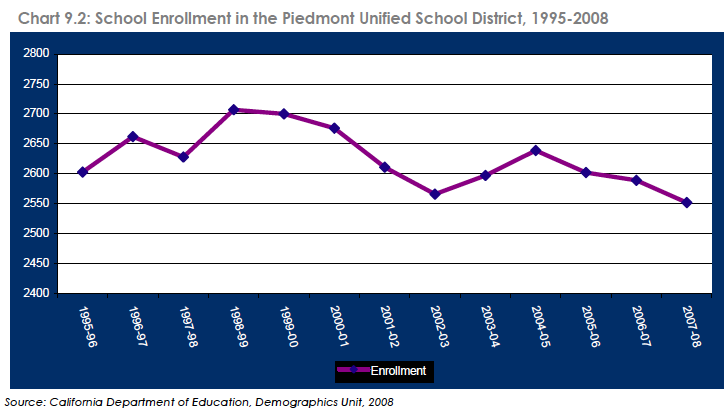
*Enrollment has dropped from a high of 2700 in 1998/99 and has remained relatively flat since 2007/8.


Read More in this series of articles examining Piedmont School Finances:

Oct 28 2012

The Municipal Tax Review Committee (MTRC) is appointed every 4 years and has an important charge –

The MTRC was not put in place to “offer suggestions and ideas”.   The MTRC, appointed by Council every 4 years for some 20 years now, does a thorough review of city operations to determine the level at which to set the parcel tax for the next 4 years.   It goes through an intense period of meetings with city department heads and provides Council a parcel tax rate structure.   At the same time, it makes recommendations about city operations and financial management.   For example, the 2011 MTRC compared Piedmont’s operational costs to other cities, which can be found on page 22 of the report.

As to the parcel tax, the 2011 MTRC made the following statement:

“Although the committee in concept supports renewal of the parcel tax to be levied in its full amount and structure, the committee had much discussion concerning whether or not conditions should be placed on its recommendation.

Fundamentally, the City’s projected revenues and current expense commitments don’t align and the committee recognizes that passing the current parcel tax without addressing expense commitments is not fiscally prudent. Further, the committee understands that certain expense reductions recommended above will take time and negotiations to implement – more time than is provided by the committee’s current schedule for submitting its report. The committee has grave concerns that without implementing the above steps, not only will the parcel tax not cover planned expenditures, but also that renewal itself is at risk if the public lacks confidence in the City’s fiscal management.”

That is a very qualified endorsement of the parcel tax and I think it is inappropriate to accuse members of “changing their minds”.  I, for one, appreciate the unprecedented advice of the Committee that we consider public confidence before putting the tax on the ballot.  That is why I did not endorse the parcel tax and directed voters to read the MTRC and BAC reports. I think a goal of both reports was to alert the public to the $40M unfunded pension/benefits liability the city is facing. A majority of the MTRC does not think Council has taken sufficient action to address that problem and that renewing the tax at this time is imprudent.

Piedmont Council Member Garrett Keating

Editors’ Note:  The opinions expressed are those of the author and not necessarily those of the Piedmont Civic Association.  The Piedmont Civic Association does not support or oppose candidates or ballot measures.

Oct 28 2012

Respect the Facts, Vote NO on Y.

Rather than implement needed cost cutting measures, the City Council has put Measure Y on the ballot and supported it with a “gloom and doom” scenario should the tax fail. First we hear the three-minute ambulance response is at risk, then the Oct. 18 Piedmonter cited Mayor Chiang: “public safety services will be preserved.” Proponent “facts” are constantly shifting.

In 2004, City Hall chose the most expensive Pension plan in the state. Our compensation plan is so generous that a recent Piedmont Police Chief retired at an initial monthly pension of $18,918, 28% more than the final monthly salary of $14,791. This type of spending is wholly unsustainable, yet the City Council refuses to take meaningful action.

Beyond the structurally unsound compensation system, financial missteps have exacerbated the failing financial picture. Six weeks into the Undergrounding Debacle, the overruns were already $161,000 more than the contract amount and contingency! City Hall’s response: don’t tell anyone and keep digging. Total taxpayer cost: $3,100,000 in overruns and litigation costs.

Not learning from its mistakes, the City Council then approved the failed Blair Park Sports Fields with the same lack of risk assessment that had taxpayers picking up overruns in the Undergrounding.

Failure of Measure Y will leave Piedmont’s quality of life entirely unaffected and will encourage the Council to implement needed cost cutting measures.

Respect the facts, ignore the scare tactics and vote NO on Measure Y.

Rick Schiller, Piedmont Resident

Editors’ Note:  The opinions expressed are those of the author and not necessarily those of the Piedmont Civic Association.  The Piedmont Civic Association does not support or oppose candidates or ballot measures.

Oct 25 2012

Vice Mayor Fujioka Describes City Actions –

As a member of the Piedmont City Council since 2008, I have tried to be a voice of reason and to act in the best interests of our entire community. Recently, we have witnessed a spirited discussion about whether the Municipal Services Tax (Measure Y) should be renewed. I am concerned that the “big picture” (the City’s fiscal health) has been lost in the heat of the moment. Vocally opposing Measure Y are Ryan Gilbert and Tim Rood, both of whom I ran against in 2008 and 2012, respectively, in two of the most hotly contested races in recent Piedmont history. From those two campaigns, I know we share an interest in strengthening the City’s financial condition. The most fiscally responsible means to that end is to pass Measure Y. Here are some important facts that I hope will be useful in making an informed choice.

The City’s successful negotiations with labor unions resulted in recently executed contracts without costly litigation or disruptive labor strikes. Negotiations with the firefighters’ union were difficult and protracted. They took over one year, went to impasse, and a state mediator was brought in because the City held firm in its demand for concessions. Labor contracts cannot be changed overnight or unilaterally. They must be negotiated within legal constraints of confidentiality and good faith bargaining which was done.

The City froze employee salaries for the 4th straight year, increased employees’ contributions to pensions, and instituted a two-tier system where new hires receive reduced pension benefits. As the Council begins negotiations for the next round of labor contracts, we will continue to work hard to reduce pension and benefit costs.

The City Council has made fiscally responsible decisions that saved the City hundreds of thousands of dollars. The Council voted to eliminate two positions which saved over $400,000 per year. It voted to share the City’s fire chief with the City of Albany for a savings of approximately $140,000 per year. It approved contracts with the City Clerk and Public Works Director that saved $60,000. It established a 5 year fiscal plan and created a Budget Advisory Committee which recommended renewal of the parcel tax. The City took over management of the pool and realized a surplus of over $31,000 in 2011-12. If sales of passes continue on the same trajectory, the City will break even or realize a modest surplus in 2012-13.

Renewal of the parcel tax will generate approximately $1.63 million per year or over $6.5 million over 4 years. These funds pay for our police, fire, and paramedic services, maintenance of streets, sidewalks, parks, playgrounds, and public buildings. The revenue supports other services that make Piedmont safer, including the City’s new Email Alert System, crossing guards for our school children, traffic studies, and public education on crime prevention and disaster preparation.

The revenues from the parcel tax will stave off painful cuts. This is not a “scare tactic.” It is arithmetic. The City cannot sustain the loss of $6.5 million in revenue over 4 years without cuts. If Measure Y fails, cuts could come from our facilities (pool, civic buildings) and equipment (ambulance, fire trucks) replacement funds which the Municipal Tax Review Committee strongly recommended be funded. Maintenance of public spaces may be reduced and library services eliminated.

If you think the tenor of our public dialogue has deteriorated over Measure Y, imagine the rancor that will occur when citizens are pitted against each other to save their favorite service or program.

Engaging in public discourse on the City’s spending priorities is healthy for our community, but denying it an essential source of revenue is not. I urge you to vote “yes” on Measure Y.

Margaret Fujioka
Vice Mayor

Editors’ Note:  The opinions expressed are those of the author and not necessarily those of the Piedmont Civic Association.  The Piedmont Civic Association does not support or oppose candidates or ballot measures.

Oct 25 2012

City Hasn’t Made Progress on Reforms-

I received our property tax bill this week. Included is $471 for the Municipal Services Tax. In the big scheme, it’s not a lot of money. Oh, I know that the entire $6 million raised over the last several years with the current parcel tax was wasted on an undergrounding project and an aborted sports field project, and was misspent on excessive employee compensation, especially fringe benefits. But that’s water under the bridge. Institutions, including City Councils, make mistakes. As long as they learn from their mistakes, progress, albeit costly, has been made. But wait – What project management practices have been put in place so these mistakes are avoided in the future?

And wait – What about the $40 million unfunded liability for future employee benefit costs that I’ve been reading about? That’s not water under the bridge; it is a torrent of water rushing at and possibly devastating the bridge. Who’s going to pay for that? That’s $10,000 per household. What happens when that bill comes due?

The City Council says we’re making good progress. A two-tier pension system for newly hired employees that will not have a material effect for 10–20 years and will have no effect whatsoever on the $40 million unfunded liability for current retirees or the 94 current employees. Doesn’t appear to be much progress to me. The City Council notes employees are paying $100 per month towards their retiree health benefit.

Let’s see:
That’s $112,000 per annum applied against a taxpayer funded benefit package of $5.7 million. Not much progress there. Employee contracts expire soon; for miscellaneous, non-safety employees in December 2012 and for fire and police in June 2013. Let’s see what progress can be made by our City Council in labor negotiations to rein in benefits costs funded by taxpayers.

If the City Council moves to lessen the burden on taxpayers for employee benefits and develops a plan for fiscal responsibility, the Municipal Services Tax can be put up to a vote in early 2014. This coincides with the next City Council election and provides an opportunity to vote on candidates and the tax at the same time.

So, for now, I’ll vote NO on Measure Y.

It is not “business as usual”.  It is time to demand fiscal responsibility from our elected officials. Visit www.NoOnMeasureY.com.

Eric Lindquist
Member, 2011 Municipal Tax Review Committee

Editors’ Note:  The opinions expressed are those of the author and not necessarily those of the Piedmont Civic Association.  The Piedmont Civic Association does not support or oppose candidates or ballot measures.

Oct 25 2012

Recommended postage for ballots ranges from $.45 to $1.50 –

The instructional insert sent with absentee ballots calls for  $.85 postage for Piedmonters’ vote-by-mail ballots for the November 6 election. However, the weight of the 2 ballots, plus envelope, for Piedmont voters is less than 2 ounces, for which the Post Office requires $.65 (one $.45 first class stamp plus a $.20 extra ounce stamp), not $.85.

The Alameda County Registrar of Voters website recommends the following postage for the November ballot:

Recommended Postage:
$ 0.85 for 2 to 3 ballot cards
$ 1.50 for 4 ballot cards

In Berkeley, there has been considerable confusion among Berkeley voters about how much postage to use for  their envelope containing four ballot cards.  The Berkleyside website has posted several articles on the subject.

City Manager Christine Daniel said the vote-by-mail ballot requires $1.50 in postage, according to County Registrar of Voters Dave Macdonald. … Mayor Tom Bates said he asked his wife, Senator Loni Hancock, to ask Secretary of State Debra Bowen about the mail-in ballots, and Bowen said a regular first-class stamp would do the trick.”

Berkeley Councilwoman Susan Wengraf  reported that, “I did call Dave Macdonald,” adding that he told her that, “regardless of what was on the ballot, it will be delivered.”

Voters confused by the postage issue can drop off their ballots at the office of the Alameda County registrar of Voters in Oakland, at 1225 Fallon St.  On election day, Nov. 6, voters can drop off ballots at any polling location until 8 p.m.

Oct 23 2012

Measure Y  a Regressive Tax –

I imagine you have now received your 2012-13 property tax statement. Have you looked at the 15, yes 15, fixed charges? Well, we collectively voted for these, one way or another.

Now, to many in Piedmont, these charges represent the cost of providing excellent services, a theme endlessly repeated but nevertheless true.  > Click to read more…

Oct 21 2012

Parcel Tax Defeat Will Not Solve Problems-

 I too have been reading the pamphlets and news articles searching for the logic behind a no vote for Measure Y.  The opponents have cited three main reasons to vote no:

1. A few years ago the staff and council was in charge of an undergrounding project that went very wrong;

2. Employee pension obligations are unsustainable;

3. The tax is unnecessary because it won’t lead to cuts in emergency services.

I don’t dismiss the importance of these three issues, but nixing the parcel tax cannot address the first two and is beside the point on the third.

Money lost on the undergrounding fiasco can’t be recovered, and so we must learn from our mistakes and move on. I guess the idea with a no vote is to “send a message” to elected officials and department heads.  But if the council didn’t hear the message loud and clear by now, then we need a new council (see below).

Secondly, like many local governments across the state the city employees’ compensation seems to be out of scale with revenue and public support and probably should be adjusted downward. But negotiating with employees and their unions is a long-term process that can’t be fixed in a single year. So if we can’t afford to keep them with present revenues, how are further cuts going to make things better?  The city has already taken steps to reduce its future obligations and may need to follow that course of many years if not decades.

Lastly, the idea that a defeat of Measure Y won’t cut police and fire services suggests that the rest of city government is unimportant. As is typical in cities around the country, when cuts finally are made, it is fire and police services that are the last things to be touched. Which means that everything else is on the chopping block, from recreation programs (including the pool) to street maintenance.  And I think Piedmont is a great city because of ALL the city services, not just its 911 services.

If this debate has taught us anything, it is that financing a city is complicated.  But you cannot “vote with your pocket book” to change government policy.  The way to change that is by electing hard working and intelligent leaders to make good decisions.  I think we have some of those kinds of people running the city right now, but if you disagree, you’ll have your chance to change that when the next election rolls around.

Tom Gandesbery, Piedmont Resident

Editors’ Note:  The opinions expressed are those of the author and not necessarily those of the Piedmont Civic Association.  The Piedmont Civic Association does not support or oppose candidates or ballot measures.

Oct 21 2012
What Essential Services Would Suffer if Measure Y Fails –
As election day approaches I am urging people to use their heads and not their emotions and to vote No on Measure Y.

Why?  I have yet to hear an honest, forthright response from the City Manager or the City Council to requests for factual information on exactly which essential city services would suffer or be cut out if Measure Y fails to pass.

An informed electorate deserves facts, not half-truths nor appeals to “doom and gloom” scenarios.  No one has provided me or the rest of the voters with information from responsible sources that can be used to assist voters in their choice at the polls on November 6th.  Surrogates with opinions abound, but responsible city governance has been factually silent.

I believe in responsible city government with the best interest of the taxpayers, not vested interests, at heart.  Until I see this happen, I will vote No on Measure Y and urge other Piedmonters to do the same.

Jim McCrea, Piedmont Resident

Editors’ Note:  The opinions expressed are those of the author and not necessarily those of the Piedmont Civic Association.  The Piedmont Civic Association does not support or oppose candidates or ballot measures.