Aug 4 2012

Tax Committee recommendations partially implemented, but benefit costs continue to rise-

After numerous closed sessions, the City Council has reached consensus on a new employment contract for Piedmont Police Officers, recommended by Finance Director Mark Bichsel.  The Council will vote on the contract at its meeting on Monday, August 6. > Click to read more…

Aug 4 2012

Board, on which Piedmont participated, was a “case study in lax oversight”- 

The 2011-2012 Alameda County Grand Jury reviewed the failure of the Associated Community Action Program (ACAP) in March 2011, finding it “a tragic but excellent example of what can happen when a board does not adequately oversee the organization for which it is responsible.”  ACAP was dissolved “as a result of serious financial concerns and significant non-compliance with laws and regulations,” according to the 2011-2012 Alameda County Grand Jury report. > Click to read more…

Jul 24 2012

Past Council and Voter Decisions Create an Unpleasant Surprise.  How did it happen? – –

The City has maintained an independent Police and Fire Department since 1907.   Initially Piedmont maintained its own retirement fund for police and fire personnel.  Contribution levels and investments were the responsibility of trustees consisting of Piedmont citizen and staff (including at various times the Mayor, Vice Mayor, and representatives from the departments).  Eventually Piedmont switched to CalPERS pensions.  For many years, the City’s safety personnel were covered under the CalPERS retirement plan of 2%-at-50.

(The annual retiree benefit is derived by calculating 2% of the highest compensation year, then multiplying by the number of years worked.  Example: Highest year salary of $132,000 x 2% x 32 years of employment.)

Changes in the fire and police retirement plan were added to the City Charter as of 1979:

“The pension system for members of the police and fire departments as set forth in Section 47 of the Charter in effect on January 1, 1979, shall be incorporated in the City Code, and any amendment thereto shall not be effective unless approved by a majority of the voters voting thereon at a general or special election.”

At 2%-at-50, the fire and police pension plans were more generous than miscellaneous employees plans:  they permitted safety employees to retire at age 50 rather than 60.  The 2%-at-50 pension plan was the standard for public safety members throughout California until 2000, when legislation was passed authorizing CalPERS to offer 3%-at-50 and 3%-at-55 plans for public safety members.  At the same time, CalPERS added new plans for miscellaneous employees:  2% at 55 to 3% at 60, with fractional increments within that range. 

A seemingly small change  – from 2% to 3% –  in the new plans represented  a substantial pension increase:  50% greater pension benefits for the rest of the employee’s life.  To illustrate, at retirement with a salary of $132,000 after 30 years of employment:

  • A 2% plan = >  $132,000 x 30 year x 2%  =>  60% pension of highest year of compensation would result in an annual $80,000 pension for lifetime
  • A 3% plan  = >  $132,000 x 30 years x 3%  => 90% pension of highest year of compensation would result in an annual $120,000 pension for lifetime
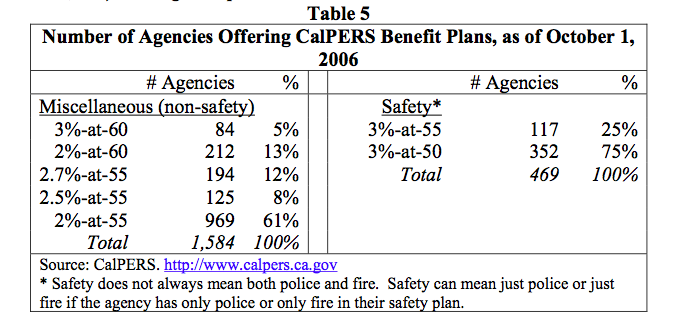
CalPERS predicts little or no cost to Piedmont for increasing pensions by 50%

CalPERS advised cities and other employers that the large increase in retirement pensions should cost the employer little – or even nothing – anticipating its investment earnings would cover all or most of the cost.  After the 3%-at-50 plan became standard for the State of California employees, fire and police employees for Contra Costa and Alameda counties were offered the 3%-at-50 plan and the plan spread among California cities.  According to Piedmont staff, the City began having trouble retaining its paramedic/firefighters.  Turnover costs were high:  Piedmont is required to pay full salary during the lengthy Academy Training period for every new hire.   (Hiring and turnover within the Piedmont Police Department appears not to have been a significant issue.) 

Partially in response to labor market conditions, and with assurances from CalPERS and staff of limited cost impact, Piedmont followed suit and approved increases for police and fire pensions.

Police and fire pensions were increased from 2%-at-50 to 3%-at-55 plan as of January 1, 2004.   The change included police as well as fire, despite a lack of reported turnover or hiring issues within the Police Department.  This change represented a 50% increase in pension pay each year after retirement.  The increased pay continues until death of the retiree and his spouse. 

(The change was negotiated as part of employee contracts approved by the Council.  It was subsequently affirmed by a city-wide vote, as required by the 1979 City Charter requirement.)

On January 1, 2004, pension plans for Miscellaneous employees also jumped from 2%-at-60 to 3%-at-60, a 50% increase in pension pay for life, though no hiring problems were publicly noticed.

On January 1, 2008, police and fire were enhanced again, going to a 3%-at-50 plan which reduced the age of retirement from 55 to 50.

A Hidden Cost Increase: Retroactive Pension Upgrade

Each time the pensions were increased, Piedmont increased the pensions retroactively for current employees.   As a result, instead of increasing pensions from (for example) 60% to 70%, pensions jumped from 60% to 90%.  The impact of a retroactive versus a non-retroactive pension increase is shown below, using the example of a 2% pension changing to 3% after 20 years of service, and retirement occurring after 30 years:

initial 2% pension = 60% pension

(past 20 years x 2% + future 10 years x 2% = 60%)

non-retroactive increase to 3% = 70% pension

(past 20 years x 2% + future 10 years x 3% = 70%)

retroactive increase to 3% = 90% pension

(past 20 years x 3% and future 10 years x 3% = 90%)

The decision to increase pension benefits retroactively has resulted in an extra $8 million liability to the City of Piedmont to CalPERS, known as the “Side Fund”.  This liability is currently being paid off at an imputed interest rate of 7.75% (a rate mandated by CalPERS).  Annual payments to retire the side fund will end in approximately 10 years.  This Side Fund contributes to the City’s high pension costs.

44% pension costs an unpleasant surprise

CalPERS’s “no cost” promise was based on rosy investment earning projections which failed to materialize.*  Rather than being “no cost”, past decisions to increase pensions have resulted in large increases in Piedmont’s pension costs.

These increases, imposed by CalPERS and not controllable by the City, have come as an unpleasant surprise.  The cost of increasing pensions and the cost of retro-activity were not anticipated at the time these past decisions were made.   While the City anticipated an increase in police and fire pensions to 33% of salary, it never anticipated rates would rise to the current level of 44% of salary, according to staff responses to inquiries at a BAFPC meeting.  This difference represents an unanticipated 33% jump in Piedmont pension costs.  For example, using the $132,000 salary that a firefighter might receive:  

33% annual pension cost => $43,560 per year anticipated

44% annual pension cost => $58,000 per year incurred

Difference:  the pension cost is 33% more than anticipated

Piedmont’s contribution costs for police and fire pensions are projected to continue rising beyond 44% in the next 5 years.   And even with these escalating contributions, the CalPERS pension pools in which Piedmont’s employees  participate will be left underfunded by CalPERS.

The Budget Advisory and Financial Planning Committee (BAFPC) has determined that Piedmont’s current pension plans are unsustainable. (See BAFPC report.)  It calculated that CalPERS pensions are underfunded by roughly 80% as to active employees.  The BAFPC also calculated that Piedmont faces $40 million in total unfunded pension and medical benefit liabilities as of 2012 – and an ever-increasing unfunded liability in the future – without substantial changes to its current pensions and benefit structure.  Recent changes in employee contracts have not addressed the ever-increasing unfunded liability which Piedmont faces.  Piedmont revenues are increasingly being diverted to pay a high cost for retiree benefit contributions – yet failing to fully fund pensions for employees who will be retiring in the future.

Piedmont faces ever increasing unfunded liabilities

A City consultant has estimated the City’s future CalPERS contribution cost increases using “high-middle-low” range projections.  The low and medium ranges were close in cost, predicting about a 2% rise per year in the next few years.  The “high” range suggests an alarming possibility:  pension contributions as high as 75% of salary within 5 years.

It should be noted that an annual CalPERS pension increase of “2%” is pegged to base salary, rather than current pension cost.  As a result, an innocuous “2%” increase in the CalPERS contribution rate actually represents a hefty 5% increase in benefit costs. 

44% pension cost on $132,000 salary:  $58,000 cost

2% CalPERS cost increase calculated on full salary:   $2,640

$2,640 represents a 4.55% (not 2%) annual increase in pension costs of $58,000

In the same way, Piedmont’s CalPERS costs may be described as having “increased 15%” over the last 5 years.  Yet this CALPERS accounting terminology, which refers to 15% of salary, disguises an actual cost increase of almost 50% compared to the historical pension costs.  This is a second instance where traditional CalPERS terminology tends to obscure the actual increase in pension costs.

Traditional municipal accounting formats also tend to hide rising pension costs.  First, ongoing increases in pensions totaling 50% in 5 years are not reflected by a year-over-year budget.  Second, 5-year budget histories, often part of a yearly budget, are brief summaries which leave pension and benefit increases buried within other figures.  Third, the very helpful initial 5-year budget projections completed as part of the 2012 BAFPC efforts did not highlight or unmask pension cost increases.  (Pension costs were first detailed only as a percent of salary, and then converted directly into percent of total compensation figures in combination with other benefits.  The increase in pension costs as a percent of past pension costs was not calculated, nor highlighted via separate sidebar figures.)

Standard accounting formats thwart the easy tracking of a rise in benefit costs, making it difficult for lay persons tasked with monitoring these and other City benefit costs to do so.   The Finance Director, Mark Bischel, has plans for new and improved BAFPC budget information next year which will be more “granular”.  This is intended to allow more key budget costs to be identified, highlighted, and tracked through the budget process.  New spreadsheets will also allow revenue and expense variables to be “played with” to assess their cost impact and model the future effects of various options.

Doing the Math:  Calculating Actual Pension Cost

Pensions are affected by a number of factors:  age of retirement (50 vs 55 vs 60), using the highest 3 years vs 1 year of salary, vesting rate (2% vs 3% per year of employment) and assumed earnings rate on the pension fund.  Analysis by the Budget Advisory and Financial Planning Committee indicates the vesting rate (2% or 3%) and earnings rate have the greatest impact on the contribution cost of pensions.

Piedmont calculates “salary” for public safety employees using the highest year of salary, rather than an average of the 3 highest years of salary.  Either option is available under CalPERS.   A member of the BAFPC pointed out that this practice can lead to “gaming” and may be encouraging turnover in the Police Department:  two past Piedmont Police Chiefs chose to retire little more than a  year after being promoted to Police Chief, with the increased retiree benefit that went with it after 1 year.

Pension and other retirement benefits for Piedmont employees have been projected to increase over the next 5 years as follows:

  • Pensions:   5% per year
  • Medical:  7% per year
  • Dental:  5% per year
  • Vision:  3% per year

In absolute dollars, pension contributions (up to 44% of salary) represent a much larger cost than the other benefits.

Returning to lower 2% pension plans for new hires, a provision negotiated in recent employee contracts, will reduce future overall pension contribution costs at some distance point in the future, but has little or no immediate effect on current budgets.

Restoring the “average of the 3 highest years of employment” to calculate pension benefits for new hires will help prevent aberrant pensions and rapid turnover, but has little immediate effect on Piedmont costs. 

Initiating $100 per month employee contributions for the medical retiree trust fund cannot halt the ever-escalating unfunded liability the City faces in this benefit.  Maximum potential employee contributions would amount to less than $120,000 per year, while annual contributions of $1.6 million per year are required to halt the escalation of this unfunded liability.  Some cities have moved to eliminate the medical benefits.  The Piedmont Unified School District limited medical for retirees to age 65 approximately 2 decades ago.

The BAFPC describes the current pension and benefit structure as unsustainable.  To ensure future employee pensions are funded and halt escalating unfunded liabilities, transitioning to defined contributions plans is recommended.

*Many are familiar with the recent losses by CalPERS during the 2008/09 financial crisis,  but CalPERS losses have not been limited to the recent financial crisis.  In late 2003, the Piedmont City Council adopted/approved  a ballot argument and rebuttal in support of Measure S (for the 2004 ballot) which stated, “More than half of Piedmont’s increased pension costs are caused by past investment losses by the State pension fund.  Piedmont’s annual pension contribution will increase by $600,000 even without any pension plan changes.”


Jul 24 2012

City of Piedmont Finance and Human Resources Director Mark Bichsel announced today that he will retire from his position with the City effective February 2013.  

Mr. Bichsel, a Certified Public Accountant, worked both in the public and private sectors before being hired by the City in 1992. Over his years with Piedmont, he has brought increased professionalism to the Finance Department. “My greatest achievement as director has been to assemble such a qualified and competent Finance and Human Resources staff,” said Mr. Bichsel.

“The City of Piedmont has benefited tremendously from Mark’s service over the past 20 years. We have been extremely lucky to have such a competent and talented individual as Finance / Human Resources Director for all these years,” said City Administrator Geoffrey L. Grote. “I wish him the best in his retirement.”

Mr. Bichsel will remain with the City until February of 2013 and recruitment for a new Finance / Human Resources Director will likely commence in the fall of 2012.

Jul 17 2012

The City will be meeting with State mediators to attempt to work out an agreement with the public safety bargaining units.  Being in the midst of negotiations, the City did not disclose points of disagreement.  However the 2011 Municipal Tax Revenue Committee (MRTC) along with the Budget Advisory and Financial Planning Committee have pointed out the need for significant changes in compensation for all Piedmont employees.  Recently, certain employee groups have agreed to reducing pension provisions for new employees, creating a “2-tier” pension plan, and  contributing $100 per month to their underfunded retiree health benefit.   These new provisions are intended to provide budgetary relief in future years.  The City currently faces $40 million of unfunded pension and medical benefits.

Jul 17 2012

On Monday, July 16 the City Council considered the establishment of a new Athletic Facilities Preservation Fund.

Looking at the lack of reserves or ongoing funding for capital replacement of sports fields, Board of Education President Rick Raushenbush had previously prepared a document for the School Board suggesting the need for a designated source of funding for facility replacement costs estimated at hundreds of thousands of dollars.  The Athletic Fund proposal is the outcome of several months of discussion between the City and the School District regarding this issue.  The City and the School programs both utilize many sports facilities owned by one or the other, while not always sharing expenses.  Legal limitations on the School District’s ability to charge users for facility replacement, rather than operating costs, is another issue.

The proposal included a $25 annual fee from Piedmont Recreation Program users, but does not require School District users to make a contribution to the fund.  The School District maintains a separate reserve to pay for replacement of field turf, gymnasium flooring, and other structural items.  The allocation amount from the Athletic Facilities Preservation Fund to the School District was not specified.  > Click to read more…

Jul 16 2012

Council Member Keating Highlights Change to New Athletic Fund Plan.  This matter will be discussed tonight, Monday July 16.  –

The Athletic Facilities Replacement Fund on Monday’s agenda has changed significantly from that initially proposed in October, 2011. The principal change is that the $25 fee will apply only to participants in sports activities administered through the Piedmont Recreation Department. Members of the private sports organizations will not be charged the fee when using city facilities – Linda Beach Field, Coaches Field, Hampton Field and the Swimming Pool. Based on this revision, annual revenues of the fund are projected to decline from $145,000 per year to $68,000 per year.

Garrett Keating, Piedmont City Council Member

PCA LINKS:  PCA Article and City Staff Report

Jun 30 2012

PERS Contract, Sewer Rehabilitation Project, Tax Renewal, Ballot Arguments, KCOM Funding

The City Council on Monday, July 2, 2012, will continue to consider in closed session pending litigation in the matter of Friends of Moraga Canyon v. City of Piedmont and potential litigation on Blair Park.

At the 7:30 p.m. meeting the Council will begin the official process to place the renewal of the City parcel tax on the November 6, 2012 ballot.  The required proposed ordinance is essentially the same as the current tax and  provides for 4 years of taxation between 2013 and 2017 with Council approval an annual increase up to 4% based on inflation criteria.  If approved by 2/3rds of those voting on the measure, funds would go toward City services.  This year the current parcel tax generated approximately $1,550,000.   It expires on June 30, 2013.

The Council will also consider procedures for an argument supporting the parcel tax measure and any rebuttal to an argument filed against the parcel tax renewal.   The failed February 2012 Sewer Surcharge Tax argument drew questions regarding participation by a majority of the Council outside of the public process.

KCOM funding will be changed in the future according to State legislation.  The Council will consider an ordinance on video franchising.

A revised CalPERS (California Public Employee Retirement System) contract for miscellaneous employees will be considered.  The revision reduces retirement compensation for new employees from 3% at age 60 based on their highest year of compensation to 2% at age 60 based on the average of their three highest years of compensation.  This change has been approved by the bargaining unit and the City Council.

The City will rehabilitate the High School and Middle School sanitary sewer mains.  To accomplish this, the staff proposes an agreement with J. Howard Engineering, Inc. in the amount of $65,960.  The construction budget for the project is set at $103,470.

Other agenda items include: Community Development Block Grant for disabled access to Beach recreational facilities, Alameda Clean Water Program participation with a 15 year term, and a contract with Coastland Engineers to become Piedmont’s City Engineer, per the City Charter.

View the full agenda and staff reports here.

Jun 21 2012
A response from the Chair of the 2011 Municipal Tax Review Committee to a recent Piedmont Post Opinion from Council Member Jeff Wieler –
In his last two “Piedmontage” columns in the Piedmont Post, Councilmember Jeff Wieler argues that the City has solved the problem of employee benefit costs and that City finances are in good shape.  He criticizes those who see the issue otherwise as “glass half-empty” types.  Sadly, Jeff is ignoring some critical facts:

•       The new City budget is up by $389,000, and 94% of that growth is due to increases in the cost of employee benefits.  Overall, benefit costs are up by 6%, but 12% for the police.  Benefits are at an all-time 26% of the total City budget.  Every $100 of salary is accompanied by almost $60 of benefits.

•       The recent report by the City’s Budget Advisory and Financial Planning Committee estimates that the unfunded liability for employee future benefits is about $40 million, which is twice the City’s annual budget.  This comes to about $400,000 for every current City employee, an amount that would shatter Jeff’s metaphorical glass.  Or about $10,000 for every household in town.

Jeff asserts that the City did not go to the current high benefits until 2008.  In reality, the City committed to them in 2003 and proposed to double the parcel tax in 2004 to cover the costs.  That doubling [of the parcel tax] was turned down by voters, but the benefit commitments went ahead anyway.

Jeff also asserts that critics of excessive benefits want City employees to work for nothing, which is absolute nonsense.  But given that Piedmont’s benefits are among the richest in the state, it is not unreasonable to expect employees to cover future cost increases.

Jeff’s point is that the City has done all it can to control benefits and we need to renew the parcel tax to keep the City budget healthy.  Then, predictably, he asserts that failure of the parcel tax vote will cost the City its 3-minute ambulance response time.  I’m not arguing against the parcel tax, but it has nothing to do with the 3-minute response – that is entirely a function of City geography, boundaries and the location of the fire station.

But one could conclude that if the City truly controlled its benefit costs, it might be able to reduce the parcel tax.  That’s a glass half-full I could drink to.

Michael Rancer
Chair
2011 Municipal Tax Review Committee


Editors Note:  The opinions expressed are those of the author and not necessarily those of the Piedmont Civic Association.

Jun 12 2012

Council’s Opportunity to Address Unfunded $40 million liability –

A Member of the Piedmont 2011 Municipal Tax Review Committee submits a letter responding to “Piedmontage” in the May 30, 2012 edition of the Piedmont Post:

Contrary to the misleading view expressed in the “Piedmontage” editorial, vital City services need not be reduced as there are sufficient opportunities to reduce cost in a reasonable, fair and orderly fashion particularly in the cost of employee fringe benefits (primarily health benefits for current and retired employees and contributions to employee retirement plans).  > Click to read more…