
Sep 20 2014

– “California will no longer be the only Western state that does not manage its groundwater,” said Senator Fran Pavley. –

The precise number of wells in Piedmont is not recorded. In most of the City the water table is more than 20 feet below ground level. Piedmont’s 2005 General Plan refers to the existing wells as being used for non-potable water purposes, such as watering lawns and flowerbeds.  Some old wells may have gone dry as the water table dropped.

Will the remaining private wells in Piedmont ultimately come under government monitoring or management following the state government’s new regulatory authority over groundwater use? Up until now well owners have been free to pump as much water as they wished. Last year the State Water Resources Control Board proposed the creation of “sustainable thresholds” of groundwater use. Ten new state regulators will focus on curbing groundwater depletion.

California established surface water rights in 1914. On Tuesday, September 16, Governor Jerry Brown signed historic legislation to strengthen local control and monitoring of groundwater use.  The three bills signed by the Governor – AB 1739 by Assemblymember Roger Dickinson (D-Sacramento) and Senate Bills 1168 and 1319 by Senator Fran Pavley (D-Agoura Hills) – create a framework for sustainable, local groundwater management for the first time in California history. Groundwater is a critical element of the state’s water system, making up more than one-third of California’s water supply. The bills establish a definition of sustainable groundwater management and initially focus on groundwater basins consumed by agriculture and industry but lay the predicate for monitoring all groundwater use.

“Ensuring a sustainable supply of groundwater is a critical element of addressing the water challenges facing California,” said Assemblymember Dickinson. “Over drafting our groundwater leads to subsidence and contamination; consequences we cannot afford. With these new laws in effect, California will take important steps to ensure we are protecting our valuable water supply for years to come.”

Groundwater is a critical element of the state’s water system, making up more than one-third of California’s water supply. The bills establish a definition of sustainable groundwater management and require local agencies to adopt management plans for the state’s most important groundwater basins.

The legislation prioritizes groundwater basins that are currently overdrafted and sets a timeline for implementation:

  • By 2017, local groundwater management agencies must be identified;
  • By 2020, overdrafted groundwater basins must have sustainability plans;
  • By 2022, other high and medium priority basins not currently in overdraft must have sustainability plans; and
  • By 2040, all high and medium priority groundwater basins must achieve sustainability.

The legislation provides measurable objectives and milestones to reach sustainability and a state role of limited intervention when local agencies are unable or unwilling to adopt sustainable management plans.

On the same day the Governor signed two other groundwater related bills focused on individual communities:

– AB 2453 by Assemblymember Katcho Achadjian (R-San Luis Obispo) – Paso Robles Basin Water District.
– AB 1043 by Assemblymember Ed Chau (D-Monterey Park) – Safe Drinking Water, Water Quality and Supply, Flood Control, River and Coastal Protection Bond Act of 2006: groundwater contamination.

For full text of the bills, visit: http://leginfo.legislature.ca.gov

Governor Brown has called on all Californians to reduce their water use, including private wells, by 20 percent and prevent water waste.  SaveOurWater.com and  Drought.CA.Gov provide information on conservation and the effects of the drought.

Sep 16 2014

Former Council Member Garrett Keating finds Committee rejection of proposals inappropriate . 

It was revealed by the chair of the CIP Committee [Capital Improvement Program Review Committee] at the September 15, 2014 Council meeting that the Blair Park proposal was not even evaluated for WW [East Bay Regional Park District Bond Funds worth $507,325] eligibility, because it was considered too controversial.

The charge from the City Council to the CIP Committee was to evaluate the eligibility of staff and public proposals for WW funding, and the Council repeatedly stated that no proposals were to be prejudged. On several occasions, this intention was explicitly stated to Moraga Canyon residents requesting improvements to Blair Park. It is unfortunate that the Committee chose to categorically dismiss the Blair Park proposal, which on paper would seem to be the most appropriate use of WW funds.

Public comments solicited for last night’s meeting were strongly in favor of improvements to Hampton Field, but the only improvements being considered at this time are to the tennis and basketball courts and the play structure.   And under the current design, converting the outfield to artificial turf will not be possible because of insufficient pervious surface.

Garrett Keating, Former Piedmont Council Member and Current Member of the Piedmont Public Safety Committee

Editors’ Note: Opinions expressed are those of the author and not necessarily those of the Piedmont Civic Association.  There are no recordings or minutes of the CIP meetings.
Sep 14 2014

Where is the public?

A rare opportunity for Piedmont to use $507,325 appears to be lacking general public input.

Will the City Council at their September 15 meeting open up the consideration process for comprehensive public input?

When Piedmont voters approved the East Bay Regional Park District WW Bond Funds tax measure, there was the promise that funds would be available through 2018 to improve Piedmont recreational facilities, a senior center, or parks.  Time has been slipping away as a result of delays.

With the exception of Livermore, which did not vote on the measure and will not benefit from the funding, Measure WW was approved by 72% of voters in Alameda and Contra Costa counties in November 2008.  To receive the funds requires no matching funds. Annually, every property owner in a participating jurisdiction, such as Piedmont, is required to pay $10 per $100,000 of assessed property value to provide the WW funds.

Piedmont delays in utilizing the funds originated primarily from staff and others intentions to use the money for night lighting at Coaches Field on Moraga Avenue; however, there was never a specific public hearing on the use of WW money for that purpose. There has never been a general public hearing or workshop on how Piedmonters want their $507,325 entitlement in WW money to be used. Some have likened the lack of early public participation in the decision to the controversial, failed Blair Park /Moraga Canyon sports complex proposal.

Unlike the outreach for Piedmont’s Draft Pedestrian and Bicycle Plan, there have been no community meetings or general public outreach to hear from Piedmonters on their preferences. No surveys, no Town Hall meetings, and no public hearings prior to the winnowing down to “five qualifying projects.”

Will Piedmonters be allowed to have a community voice in how to spend the fast approaching deadline for the $507,325 entitlement? 

The task of determining what should be done with the money has largely been delegated by the City Council to their appointed Capital Improvement Program Review Committee (CIP).  This select group of well intentioned members have been meeting to discuss which projects would qualify and have selected five non-prioritized projects.

The CIP meetings have been held in the City Council Conference Room, a small room near the Council Chambers, and at a meeting in the Main Park.  Those who wanted to know what was discussed at the meetings were unable to obtain meeting minutes or view the proceeding from their homes.

Interested residents concerned about Blair Park improvements, long term correction to the dangerously cracked tennis courts at Hampton, and expansion of Coaches Field have been challenged by the decision process.

Mark Feldkamp lends staff support to the CIP meetings.  Suggestions on how to spend CIP money have ranged from curtains in the Community Center to replacing Main Park’s stone walls, daylighting the stream down the center of Dracena Park and drainage issues.  Feldkamp recommended, much to the disappointment of some, that some projects were not advised.  He has encouraged the Park Commission to be present at the September 15 Council meeting to participate in the decision process. 

It is unprecedented for Piedmont to receive $507,325 to spend on unspecified recreation facilities, a senior center, or parks.

Some public frustration is evident from the emails found in the staff report and emails . There are competing interests for sports, beautification, recreation and park improvement. Blair Park’s Council approved plans are not on the list for funding.

The five projects chosen by the CIP committee are listed below.

Partial staff report for September 15 City Council meeting:
EAST BAY REGIONAL PARKS MEASURE WW NON-PRIORTIZED PROJECT LIST

Piedmont Community Hall Plaza and $600,000 to $700,000
Connector Pathway Renovation:
This project would replace the broken and stained aggregate concrete in the Community Hall front plaza area with the existing brick paving spokes left intact. The likely material to be installed in place of the concrete would be a cut stone surfacing mortared on a steel
reinforced concrete slab that would aesthetically tie in with the existing stone pavement improvements located throughout Piedmont Park. Staff would propose to install electricity under the slab and install decorative lighting to the specimen Yulan Magnolia
located in the center of the island. This area is used extensively for parties and large functions that generate much needed revenue for the city. The improvements would also include the installation of several removable decorative metal bollards limiting the vehicular damage caused by cars and trucks that now use the plaza as a turn-around and
drop off zone.
The project would also complete the final phase of the Exedra Master Plan as recommended in prior CIP proposals. This portion of the project combines several prior projects, including the installation of a new swings for older children, new lawn area and seating along the bicentennial wall, new walkways that would replace the existing asphalt roadway, lighting along the walkway leading to the Exedra Plaza, modifications to the overlook area including improvements to better accommodate movies in the park and improvements to the driveway that leads to the amphitheater.

Hampton Park Improvements (Harris Plan) $1,500,000 (construction costs only): [Phased approach not encouraged by staff.]
The Master Plan was approved by the Park & Recreation Commissions and City Council in 2007. City Council approved funding for the completion of the construction documents that are due by November 2014 and possible bid in January 2015. The Landscape Architect has recently submitted the 30% Design Development working drawings.
Public support from the Hampton Park improvements has been strong and staff is exploring possible private funding opportunities. This project could be broken into phases, depending on the budget constraints. Project phases could include the refurbishment of all of the hardscape areas including the tennis, basketball and handball
courts. This in conjunction with the improved drainage in these areas could serve as one phase. Another phase could include all improvements at the baseball field, including all new drainage system, turf, new warning track and site furnishings. The Landscape
Architect is prepared to package the construction drawings and bid documents that would be compatible with the proposed construction budget. A decision will be needed to address what items would be in each of the construction phases.

Dracena Park, New Entrance $300,000 to $350,000
at Park Way and Dracena Avenue:
Develop an in-house master plan for a new entry patio and walkways at the corner of Park Way and Dracena Ave. The construction of the new pedestrian bridge at Dracena Park has brought to the forefront the need for a new pedestrian entrance and gathering spot at this corner of Dracena Park. The existing connector walkways to the new bridge are in need of a complete over-haul. The existing landscaping should be enhanced and an efficient irrigation system installed.

Renovation and Rehabilitation of the Recreation Building $100,000 to $150,000:
The existing structure is very antiquated and a Master Plan is needed to make better use of the existing space. As part of an overall Master Plan, staff proposes to relocate the registration and main offices downstairs to the first floor. This arrangement would be more user-friendly allowing the public to have direct and unimpeded access to
Department staff. The construction would include not only renovated office spaces but also provides improvements to the existing HVAC systems, lighting and internet services. The Recreation Department provides a wide variety of city functions and the working environments should meet these needs, allowing staff to efficiently serve Piedmont residents.

New Play Structure at the Recreation Center $75,000 to $100,000:
The existing play structure is antiquated and is in need of replacement. A new play structure would provide ADA access for all users and would invite and encourage a safe play environment. The design would have areas for all age groups encouraging the children to use their imagination as well as providing physical challenges. This play structure is in a prime central play location that serves numerous groups on a daily basis.

Read the staff report and emails for the September 15 City Council meeting agenda.

The Council meeting begins at 7:30 p.m. in City Hall, 120 Vista Avenue, Piedmont. The use of WW Bond Funds falls well into the agenda of the September 15 meeting. Home observers can tune into Channel 27 or go to the City website on line to view the proceedings.

Sep 14 2014

Waterways and streets have become cleaner.

The following is a press release from StopWaste of which Piedmont is a member.                                                                                                               

Since it began in January, 2013, the reusable bag ordinance has had dramatic results. In Alameda County, overall bag purchases by affected retail stores have declined by 85 percent. The number of shoppers bringing a reusable bag to affected stores, or not using a bag at all, has more than doubled during this time.

The ordinance, adopted in 2012 by the Alameda County Waste Management Authority, also known as StopWaste, went into effect January 1, 2013, and affects 1,300 stores countywide. The ordinance prohibits the distribution of single-use bags at most retailers selling packaged food, and places a $0.10 per bag minimum charge on recycled-content paper or reusable bags. Alameda County is the most populous county in California to have a reusable bag ordinance.

“It’s fantastic to go grocery shopping and see everyone with their reusable bags,” stated Authority Board President Jennifer West. “I think we can all appreciate fewer plastic bags flying around in the street.”

Store owners have noticed the changes first-hand. “People used to ask for two bags, now they don’t even want one,” said Rubin Dhillon, a manager at a Union City 7-Eleven. Conchita Hung of a Valero station in Dublin added, “I’ve been the owner for over 20 years – it’s been a big change. It’s changed people’s habits because they don’t want to pay 10 cents.” Other store owners reported their bag purchases going down between 50 and 90 percent.

The ordinance was influenced by tough new requirements for cities to reduce the amount of trash entering waterways. In 2007, the San Francisco Regional Water Quality Control Board declared five waterways in Alameda County – Strawberry Creek and Codornices Creek in Berkeley, Sausal Creek and Damon Slough in Oakland, and San Leandro Creek in San Leandro – so polluted with trash that they violated the federal Clean Water Act.

Despite several years of voluntary efforts to promote reusable bags countywide, plastic bags were still consistently collected in large numbers by volunteers in Alameda County on Coastal Cleanup day.

San Francisco and San Jose have seen similar decreases in plastic and paper bag distribution and cleaner waterways as a result of their bag ordinances.

For futher information contact: Jeff Becerra:

(510) 891-6549jbecerra@stopwaste.org


Sep 8 2014

At their September 8, 2014 meeting addressing short term housing rentals in Piedmont, the Planning Commission took no formal action; however, by consensus all commissioners expressed their opinion that Piedmont should not allow short term housing rentals.  Concern focused on changing the character of the community due to parking problems, noise, and instability in neighborhoods.

Referring to short term rentals, Commissioner Tony Theophilos noted only a downside and no upside.

Planning Director Kate Black expressed concern if second units were used like a hotel rather than meeting affordable housing needs.

Other commissioners were concerned that any revenue from permits, fees, or taxes would not offset the cost of managing such a program.

Former Mayor Patti White made a statement during Public Forum requesting no approval of short term rentals, largely because of inherent safety issues for young children.

The staff will prepare a report describing the various points expressed by the commissioners.

Sep 6 2014

Will Piedmont’s houses become commercialized?

Per City Council direction, staff will introduce for Planning Commission comment, discussion, and direction the topic of short-term rentals of properties in Piedmont.

Monday, September 8, 2014, the Piedmont Planning Commission will discuss short-term rentals of Piedmont housing.  Currently, there are restrictions on these increasingly popular rentals.  Complaints based on noise, unfamiliar individuals in neighborhoods, taxis, crime potentials, irregular comings and goings, and parking issues have been received by the City Council, staff, and Planning Commission. Benefits appear to go to the owner/lister while presenting problems for others.

Piedmont, long established as a primarily single-family residential city, has for a century spurned commercial encroachment on the City’s character. Use of housing for private gain while disadvantaging neighboring home owners has increasing been difficult to thwart due to internet promotion.  Money made from short-term rentals is sometimes viewed by individual homeowners as a lucrative way to off-set high mortgage payments and property tax demands.

The Piedmont City Council has asked the Planning Commission to consider the pros and cons of short-term rentals and provide advice.

The short-term rental agenda item is #10, the last item of the Planning Commission agenda at the September 8 meeting. The public is welcome  to attend or view on KCOM or on the City website :

 “you might want to tune into KCOM, cable 20 or by logging onto the city’s website at www.ci.piedmont.ca.us: on the right hand side of the homepage under the “City Council” heading, click on the “Online Video” link, then scroll down under the “Sections on this Page” heading, click on the “Planning Commission” link, then on the “September 8, 2014” heading, click on the “In Progress” (live) link, and be prepared to come on down to City Hall as the meeting progresses closer to Agenda #10.”

Some of the companies providing short-term rentals are: Airbnb, Flipkey, Craigslist,HomeAway, Roomorama, Stopsleepgo, TravelMob, BedyCasa, ZenRentals, WaytoStay, Interhome, Windu Tripping.com.

How are Short Term Rentals Currently Regulated in Piedmont?

– Renting a Portion of the House: Piedmont residents wishing to rent out a room in their house for fewer than 30 days may not do so pursuant to Section 17.39.2:17.39.2  The owner of a single family dwelling unit in any zoning district is permitted to rent one or more bedrooms in the dwelling unit, when the circumstances fit the definition of a rented room at Section 17.2.58B:

Rented room means the renting of a room or any combination of rooms within an existing single-family dwelling where:

(a) one or more rooms, including at least one bedroom eligible for use as a bedroom, is rented to a single lessee under a single rental agreement, not for the entire dwelling;

(b) for a minimum of 30 consecutive days;

(c) with the common use of the primary kitchen facilities, and with no temporary or permanent cooking facilities in the rented room(s);

(d) with either shared or separate bathroom

– Renting the Entire House: Property owners who wish to rent their entire house may currently do so for any amount of time.

– Renting an Existing Approved Second Unit That is Not a Rent- Restricted Unit – Owners with a legally approved second unit (not including rent-restricted units) may currently rent it for any amount of time.

“It is important to note that any rental, whether for one year or one day, is subject to Piedmont’s rental tax.”

A recent scan of listings in Piedmont on one website, Airbnb.com, showed 8 listings.

“It is not easy to tell what the addresses for these properties are (you must book the rental in order to get an address), but from the map, it does not appear that the current listings match the locations where we have received resident complaints, indicating that there are more properties with such listings. This is just one of the companies (and it tends to have the most market share), but it can be assumed that there are listings on Craigslist, and other internet-based sites.”

Piedmont Planning staff believes that currently, most of the owners of these short-term rentals are not paying rental taxes. Of six known, or strongly suspected property owners who are renting to short-term renters, four have not yet paid a rental tax on their properties, although two property owners who were advised by the City of the regulations, submitted Intent to Rent forms.

Effect on Housing Element – 

“In addition to the concerns expressed by Piedmont residents, staff have concerns about the effect on the City’s housing supply, especially the more affordable second units. The City has worked hard at meeting our Regional Housing Needs Assessment by providing second units and room rentals (for more than 30 days) as a way of providing lower cost housing while maintaining Piedmont’s single-family character, without the requirement of up-zoning that has occurred in other communities. Each house, second unit or room rental that is rented for short periods to different people, are units that are not providing needed housing to people who wish to reside in and create ties with the community.”

Given the direction by the City Council for an examination of this issue, there are several options offered by  the Planning Department for Commission and Council consideration:

– Prohibit all rentals for fewer than 30 days. This would require a Code change to prohibit single-family residences and second units from being rented for fewer than 30 days. Staff would need to work with the City Attorney so that the policies are developed in compliance with State and Federal law.

– Permit An Entire House to be Rented for fewer than 30 days. No change in the Municipal Code is needed, as this is currently allowed. However, the City might wish to consider a registration requirement, regular safety inspections and either the creation of an occupancy tax, which is assessed up-front, or the current rental tax. The current rental tax is assessed annually based on rent collected for the prior year. The tax is a minimum of $200 or gross receipts multiplied by .01395, whichever is greater. Property owners are required to provide tax receipts, lease agreements, or the Federal Form 1040 as proof of rent collected.

– Permit Second Units that are not Rent-Restricted to be Rented for fewer than 30 days –  No change in the Municipal Code is needed, as this is currently allowed. However, the City might wish to consider a registration requirement, regular safety inspections and either the creation of an occupancy tax, which is assessed up-front, or the current rental tax.

– Permit a Room or Rooms to be Rented for fewer than 30 days – This would require an amendment to Section 17.39 of the Municipal Code. Additionally, the City might wish to consider a registration requirement, regular safety inspections and either the creation of an occupancy tax, which is assessed up-front, or the current rental tax.

~~~~~~~~~~~~~~~~~~~~~~~~~~~~~~

Comments addressing the issue may be sent to the Planning Commission through Kate Black at kblack@ci.piedmont.ca.us or via a phone call to her at 420-3063.

Members of the Planning Commission are:

Phillip Chase, Susan Ode (Chair), Louise Simpson, Tony Theophilos, Tom Zhang, and Eric Behrens (Alternate)

Council Liaison is Tim Rood – 239-7663

Sep 6 2014

How do you know if the plan is okay?

Piedmonters should take a look at the Draft Piedmont Pedestrian and Bicycle Master Plan to find out if changes are suggested for their neighborhood or public facilities.  Will your street be changed?

After numerous meetings, Piedmont’s Draft Pedestrian and Bicycle Master Plan will be considered for environmental review with a goal of meeting California Environmental Quality Act (CEQA) qualifications.

Piedmont Planning Commission Meeting

Monday, September 8 – 5:00 p.m. City Council Chambers

 CEQA consideration is the first item on the agenda.

The Draft Pedestrian and Bicycle Master Plan and CEQA document will be  heard at the September meeting of the City’s Planning Commission. The meeting will be held on Monday, September 8, 2014 at 5 pm in the Council Chambers in Piedmont City Hall (120 Vista Avenue). At the meeting, the City’s consultant on the plan will present the CEQA initial study and negative declaration, and the Planning Commission will provide comments on the Draft Plan and CEQA document in preparation for recommendation to the City Council for final adoption. This is a very important meeting and we encourage the public to attend to provide any comments!

The CEQA document has been posted online and is available for public review. The Final Plan and CEQA document will be presented again to the Planning Commission at their October 13 meeting, and subsequently to the City Council for official adoption by the City.

Draft Piedmont Pedestrian and Bicycle Master Plan (This is a large document, which may take several minutes to download)

Appendices: Comments received through the two online surveys on the needs assessment and on the improvement options

To submit comments on the Draft Plan to the Planning Commission, please either email your comments to City Planner Kate Black at kblack@ci.piedmont.ca.us or mail them to 120 Vista Avenue, Piedmont, CA 94611 byFriday, October 3.

For more information about the PBMP, contact Kate Black at kblack@ci.piedmont.ca.us or at (510) 420-3063. If you would like to stay up to date on the development of the plan, contact Janet Chang atjanetchang@ci.piedmont.ca.us or at (510) 420-3094 to be added to the email list for the project.

Get involved—these are your streets and sidewalks. Your voice is important!

The PBMP is being funded entirely through a grant from the Alameda County Transportation Commission (CTC; www.alamedactc.org) and through the City’s existing funds for pedestrian and bicycle improvements (pass-through Measure B funds), also distributed by the Alameda CTC.

Aug 17 2014

Piedmont’s Draft Pedestrian and Bicycle Plan (PBMP) will be presented to the Piedmont Unified School District (PUSD) Board of Education.  The meeting will be held on Wednesday, August 20, at 7 p.m., in the City Hall Council Chambers (120 Vista Avenue). The presentation to the PUSD Board will focus on improvements for creating “Safe Routes to School” to encourage Piedmont youth to walk or bike to school. The meeting will be broadcast on Channel 27, recorded, and live streamed on the City website. 

Draft Piedmont Pedestrian and Bicycle Master Plan (This is a large document, which may take several minutes to download)

Appendices: Comments received through the two online surveys on the needs assessment and on the improvement options

More information about the PBMP is available from Kate Black at kblack@ci.piedmont.ca.us or at (510) 420-3063. To be added to the email list for the project, contact Janet Chang at janetchang@ci.piedmont.ca.us or at (510) 420-3094.

Aug 17 2014

Increases will be 4.57 % in 2015 and 5 % in 2016.

The California Public Utilities Commission (CPUC ) unanimously approved Pacific Gas and Electric’s (PG&E) request for increased rates. PG&E rates for all customers will increase 4.57 percent in 2015 and 5 percent in 2016. (PG&E had asked for rate increases of 5.9 percent for 2015 and 6.1 percent for 2016.)

The initial increase begins September, 2015.  PG&E estimates the average residential customer who pays $129 per month for its gas and electricity bill will see an increased charge of $7.50 per month next fall (2015).

PG&E service area covers over a 70,000 square mile area stretching from Eureka to Bakersfield with 15 million people.

CPUC released the following statement on the increase:

“After reviewing the findings of independent safety consultants and others, the CPUC adopted revenue requirements that balance the priorities of safety and reliability with just and reasonable rates. PG&E requested a 17.5 percent increase ($1.16 billion) over the currently approved revenue requirement for 2014-2016. The CPUC reduced PG&E’s revenue increase request by $700 million, authorizing an increase of $460 million, which is an increase of 6.9 percent over the currently authorized revenue requirement. The decision approved attrition increases of 4.57 percent for 2015 and 5 percent for 2016. PG&E requested attrition increases of 5.9 percent for 2015 and 6.1 percent for 2016.

Rate cases for PG&E are conducted in three-year cycles. For the first time in a rate case the CPUC retained outside experts to evaluate risk assessment, risk mitigation, programs and policies, as well as PG&E’s corporate policies, goals, culture, and the efforts being made to bolster PG&E’s system safety and reliability. The findings of the consultants, along with those of the CPUC’s Office of Ratepayer Advocates, TURN, and other intervenors were important factors in determining the appropriate level of funding to authorize.

Today’s decision authorized programs to increase the safe operation of PG&E’s system in a cost-effective manner and hold PG&E accountable for the safe operation of its system. The programs focus on infrastructure upgrades and improvements and include the creation of a Gas Distribution Control Center to provide real-time visibility and remote control of dynamic gas pressure and flows within PG&E’s system; tools to meet a superior standard of safety in detection and repair of gas distribution pipeline hazardous leaks; the acceleration of the replacement of aging distribution pipeline; tools to reduce electric outages and mitigate wildfire risk; and the replacement of poles previously scheduled for replacement in prior years (a reduction was adopted, however, to assign a share of responsibility to PG&E shareholders, rather than ratepayers, for pole replacement deferrals previously funded by ratepayers).

The CPUC’s decision also includes requirements and rate-making mechanisms that will increase the accountability of PG&E and help ensure that PG&E is using the increased revenues prudently and effectively, as well as several requirements that will improve the showing on safety and risk in PG&E’s next rate case.”

Aug 10 2014

After months of outreach, surveys, community involvement, and meetings, Piedmont’s Draft Pedestrian and Bike Plan will be considered by and presented to the  Piedmont Planning Commission at their Monday, August 11 meeting starting at 5:00 p.m. in the Council Chambers.  The meeting will be broadcast via Channel 27 and live streamed from the City’s website.  A retrievable video recording will be made of the meeting.


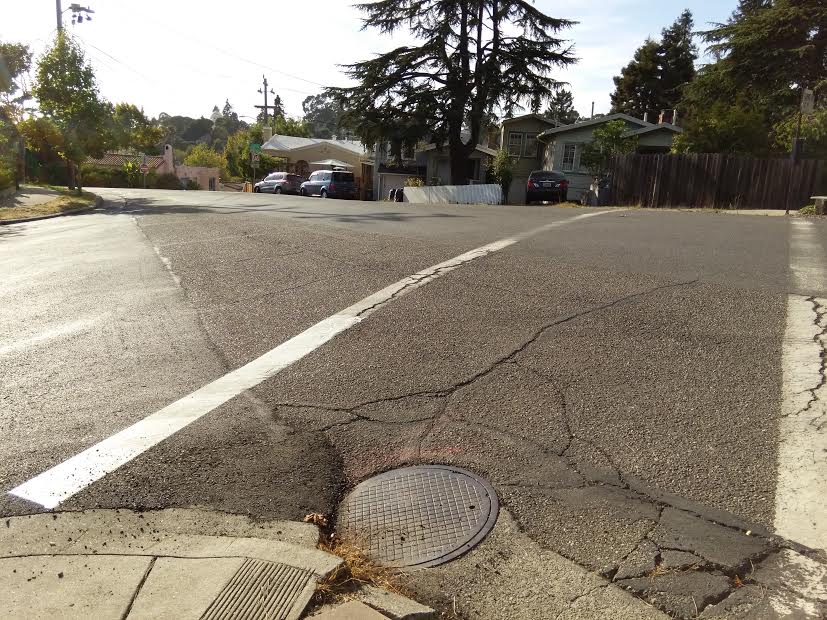
Dangerous crosswalk on Moraga Avenue

Dangerous crosswalk on Moraga Avenue

Get involved—these are your streets and sidewalks. Your voice is important!

After a months-long planning process, the Draft Piedmont Pedestrian and Bicycle Master Plan is now available for public review and comment. The Draft Plan outlines the recommended pedestrian and bicycle improvements to be carried out in Piedmont over the next ten years. The Draft Plan can be accessed at the following links:

Draft Piedmont Pedestrian and Bicycle Master Plan (This is a large document, which may take several minutes to download)

Appendices: Comments received through the two online surveys on the needs assessment and on the improvement options

The Draft Plan will be presented at the August meeting of the Planning Commission. The meeting will be held onMonday, August 11, 2014 at 5 pm in the Council Chambers in Piedmont City Hall (120 Vista Avenue). At the meeting, the City’s consultant on the plan will summarize the contents of the Draft Plan and be available to answer questions. The public is invited to the meeting to learn more about the Draft Plan and to provide any comments.

To submit comments on the Draft Plan to the Planning Commission, please either email your comments to City Planner Kate Black at kblack@ci.piedmont.ca.us or mail them to 120 Vista Avenue, Piedmont, CA 94611 by Friday, October 3.

Additionally, the Draft Plan will also be presented to the Board of Education of the Piedmont Unified School District (PUSD). The meeting will be held on Wednesday, August 20, at 7  p.m. also at the City Hall Council Chambers (120 Vista Avenue). The presentation to the PUSD Board will focus on improvements for creating “Safe Routes to School” to encourage Piedmont youth to walk or bike to school.

The CEQA document will be posted online and available for public review by the September 8 Planning Commission meeting. The CEQA document and any revisions to the Draft Plan will be presented at this meeting, including possible changes resulting from Commission and resident comments.

This Final Plan and CEQA document will be presented again to the Planning Commission at their October 13 meeting, and subsequently to the City Council for official adoption by the City.

For more information about the PBMP, contact Kate Black at kblack@ci.piedmont.ca.us or at (510) 420-3063. If you would like to stay up to date on the development of the plan, contact Janet Chang at janetchang@ci.piedmont.ca.usor at (510) 420-3094 to be added to the email list for the project.

The PBMP is being funded entirely through a grant from the Alameda County Transportation Commission (CTC; www.alamedactc.org) and through the City’s existing funds for pedestrian and bicycle improvements (pass-through Measure B funds), also distributed by the Alameda CTC.

Information above provided by the Piedmont Planning Department
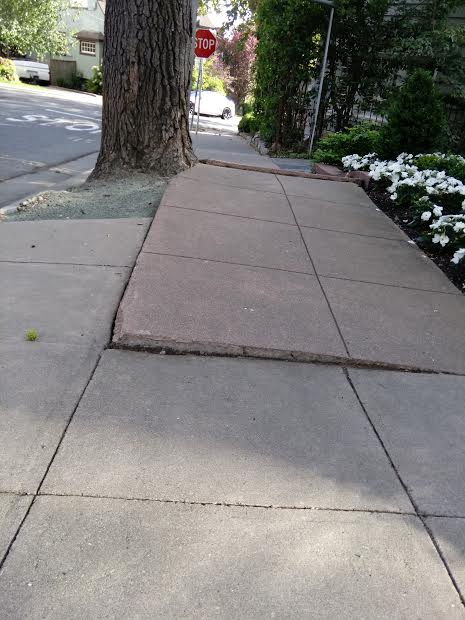
Uneven sidewalks especially challenge young and old pedestrians

Uneven sidewalks especially challenge young and old pedestrians