
Apr 16 2016

Is on-street parking a problem in your neighborhood?

  • Should parking space sizes be reduced?
  • Should lot sizes and street frontage requirements be reduced?
  • Are Piedmont cars getting smaller?
  • Do Piedmonters want smaller garages?

On April 11, 2016, the Planning Commission undertook a “Public Hearing” for consideration of changes to Chapter 17, Piedmont’s Code requirements for construction and zoning. The Planning Commission is charged with recommending Chapter 17  and Design Review regulation changes to the City Council.

Staff reports here and here.

Reduction of Parking Space Dimensions –

Working from the April 11, 2016 staff report (here), the first item considered by the Commission was reduction of parking space size requirements. Parking space dimension requirement is currently set at 9 feet by 20 feet for garages and parking configurations with an exception. After considerable discussion, the Commissioners split their votes.   Whereas Commissioners Behrens, Ode, and Ramsey voted to reduce parking space size, Commissioners Tom Zhang and Tony Theophilos wanted to retain the current size requirements of 9′ X 20′.

David Hobstetter, former Piedmont Planning Commissioner and local architect, spoke extensively, referencing his involvement with the development of the Shell Station site at Wildwood and Grand Avenues. At an unrecorded joint meeting of the Planning Commission and the City Council, proposals were presented.  Hobstetter urged reducing parking space size, explaining that fulfilling parking space requirements had been a problem for the Shell Station development project.  He emphasized the need to encourage smaller cars for the environment and noted some trends to reduce parking space sizes.

The April 11, 2016 Planning staff report states:

Parking Requirements: The parking requirements of the current Zoning Code, Section 17.16, requires that a conforming parking space be covered, non-tandem, and at least 9 feet wide by 20 feet deep. A compact parking spot must be 7.5 feet wide by 16 feet deep. The Commission approved 31 of the 35 requests [ The chart in the staff report  (herestates there were 37 variance applications with 3 denied.] for a variance from the parking size requirements submitted between 2006 and 2015, recognizing that modern cars are smaller than those that were common when the size regulations were adopted in 1976. The Commission might consider reducing the required size of parking spaces in all zones to be 8.5 feet wide by 18 feet deep for a standard space and 7.5 feet wide by 15 feet deep for a compact space. This would align with the requirements in most other cities in the region.”

COMMISSIONERS’ REASONS TO REDUCE THE SIZE OF REQUIRED PARKING SPACES:

  • Cars are getting smaller.
  • People should purchase smaller cars for the environment.
  • Development projects are penalized by requirements for large parking spaces.
  • Smaller garages will encourage Piedmonters to buy small cars.
  • Property should not be taken up with large garages.
  • Piedmont’s parking size requirement is larger than surrounding cities.
  • Variance application costs would be reduced by the change.
  • Variances are frequently approved and should be reserved for extraordinary conditions.
  • Staff time is taken up with requests for variances.

COMMISSIONERS’ REASONS FOR NOT REDUCING PARKING SPACE SIZE

  • Numerous streets are heavily impacted by cars parked on the street making driving difficult and unsafe.
  • Decades old garages are too small for today’s vehicles.
  • In Piedmont, large SUVs proliferate.
  • The statistical information provided by staff does not state the reasons variances were given in the past.
  • The statistical information provided by staff does not state the dimensions of the variances given in the past.
  • There is no staff information provided on why some applicants did not receive Planning Commission approval for a variance.
  • The hands of future Planning Commissioners should not be tied by a reduced parking space size.
  • Planning Commissioners should determine if a space should be smaller rather than have size automatically reduced.
  • Piedmont is unlike the cities mentioned as models in the staff report.
  • Small garages are a deterrent to use.
  • Smaller garages will force more cars onto the street.
  • Smaller garages are frequently used for storage rather than for cars.
  • Residents purchase a car because they want it, not because of garage size.
  • Most applicants comply with the current parking space dimensions.
  • Social engineering should not determine the size of the parking space size.

A quick survey of some nearby communities revealed that the City of Orinda sets their parking space dimensions at 9 feet by 19 feet.  The City of Lafayette notes at a minimum: “Parking spaces required to be located in a garage or carport shall not be less than 20 feet in length and 10 feet in width and otherwise meeting the requirements for full sized parking spaces.” Both sample cities require a larger size than the 8.5′ X 18 ‘ proposed.

Staff was directed by the majority on the Commission to return with language to specify a reduced parking space size requirement.

Further, the Commission directed staff to develop language to:

  • Keep the currently required number of parking spaces correlated to the number of bedrooms;
  • Propose electrical outlets within setbacks for charging electric vehicles;
  • Propose a clearer definition of “structure”;
  • Reduce setback requirements to allow eaves and other building features to intrude into standard setbacks;
  • Further define setbacks;
  • Change definition of front, side, and backyards setbacks in relation to alleyways;
  • Reduce lot size requirements for Zone A from 10,000 square feet to 8,000 square feet and street frontage requirements from 100 feet to 60 feet;
  • Propose changes to Zone E for consistency with Zone A requirements.

The Commissioners started their regular meeting at 5:00 p.m., which included their usual dinner break around 6:30 p.m.. At 7:45 p.m. the Commissioners undertook Chapter 17 matters.   By 9:00 p.m., Commissioner weariness ended the public hearing and further consideration of Chapter 17 revisions.  The Commissioners were requested by staff to return to the May meeting with the April 11, 2016 staff report to continue considerations of changes to Chapter 17.

All revised language will return to the Planning Commission for their consideration prior to submittal of final recommendations to the City Council.  The Council will then hold their own public hearing to consider the proposed changes prior to adopting any ordinances following their two required public meetings.

The current target date to finalize revisions to Chapter 17 is by the end of 2016.

Residents who have comments may submit them to:

Piedmont Planning Commission via Interim Planning Director Kevin Jackson, City of Piedmont, 120 Vista Avenue, Piedmont, CA 94611 or via email @ kjackson@ci.piedmont.ca.us

and

Piedmont City Council via City Clerk John Tulloch at 120 Vista Avenue, Piedmont, CA 94611 or email jtulloch@ci.piedmont.ca.us
Apr 16 2016

Condominium roofs now level with Oakland Avenue Bridge – 

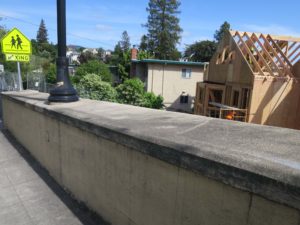
The seven townhouses designed by Jarvis Architects are now rising on the site of the former PG&E substation.  Four of the condominium units front on Linda Avenue, one at the corner of Linda Avenue under the Oakland Avenue bridge over Linda.  Three of the condominiums have views of the bridge support structure, roadbed, future public stairway and/or adjacent multi-family building on Oakland Avenue.

IMG_4250Demolition of the decommissioned Linda Avenue PG&E structure also removed the pathway leading from Linda Avenue up to Oakland Avenue beside the bridge. When construction of the townhouse development at 408 Linda Avenue is completed, a new stairway will be installed on the sliver of City land between the seven townhouses and the bridge, according to Patrick Zimski, Piedmont Station, LLC.

A preliminary design of the replacement pathway was presented to the Piedmont Park Commission on January 7, 2015.  Kevin Leveque, the landscape architect for Piedmont Station LLC explained that due to the 25% slope, it will be necessary to incorporate steps in the new replacement pathway.  The City is expected to install an ADA compliant connection between Oakland and Linda Avenues on the north side of the bridge.

Apr 9 2016

Extensive changes to Piedmont building requirements and zone uses proposed-

  • Should public property be rezoned to allow for-profit uses?
  • Should variances be easier to obtain?
  • Should parking requirements be reduced?
  • Should lot size requirements be reduced?
  • Should zoning code be changed to allow a local newspaper to occupy a City building as noted in the March staff report?

Staff proposals offer leniency and reduced restrictions for variances and other building standards. 

The Planning Commission will discuss significant revisions to the City’s Chapter 17 “parking space dimensions, secondary structures, setback measurements, for-profit enterprises in Zone B, and other topics.

Piedmonters who want to participate in changes to Piedmont’s Chapter 17 will need to wait until an undetermined time on Monday night, April 11 for the “public hearing” that follows the Planning Commission’s regular business on Design Review and variance applications.  Regular business starts at 5:00 p.m. 

Planning Commission Agenda item 11 at the end of the evening is the “public hearing” on revisions to the City’s Zoning Code (Chapter 17) and Residential Design Review Guidelines. The agenda item to consider the changes is listed as a “public hearing,” however if history repeats, few, if any public individuals will be present when proposed changes are reviewed. Publicity on the proposed changes has been limited.

The Planning Department staff typically does not make outright recommendations; however, as in this instance and for many matters that come before the Planning Commission, only one alternative is provided and pros and cons are rarely presented. 

Regarding For-Profit Enterprises in Zone B the staff report states:

“Currently only public agencies and nonprofit enterprises are permitted in City Buildings in Zone B. The Commission may want to consider allowing for-profit enterprises that provide a valuable service to City residents to be located in Zone B as a conditional use. A local newspaper or child care center might fit this criteria.”                                 

March 16, 2016 staff report

Some revisions to Chapter 17 are mandatory in order to comply with the Council and State approved General Plan and Housing Element. Other revisions are voluntary. The proposed  Code amendments are “extensive and complicated” according to the City’s Interim Planning Director, Kevin Jackson.

Read the proposed revisions to be considered  Monday night here and here.

Revisions focusing on second units include:

Incentives to support development of new second units; monitor opportunities for units in homes that do not yet have them; collecting information on occupancy and rents charged; monitor vacant units; reduce off-street parking requirement; and maintain an inventory of available units for extremely low income families.

Parking Requirements:

An off-street parking place is currently required for a second unit. Changing laws regarding parking requirements may impact neighborhoods where quality of life and safety are concerns.  Parking is an issue in many areas for homes, businesses, schools, parks, and public uses.

Setback requirements, lot size and frontage requirements, and other long standing standards are proposed to be changed.  The proposed changes are in the staff report. 

AirBnB :

In September 2015, the City Council determined that house swaps should not be regulated, but short term rentals (including online peer to peer such as AirBnB) should be prohibited in second units and apartments.  In November 2015, the Planning Commission recommended prohibition of all short term rentals in Piedmont.

At the public hearing the Commission will take testimony from members of the public on the revisions under consideration. The Commission may then provide comments or direction to the staff on updates and revisions to the City’s Zoning Code  and Residential Design Review Guidelines.

“The purpose of the hearing is to take public testimony on the subject. Citizens are encouraged to submit comments to Interim Planning Director Kevin Jackson, City of Piedmont, 120 Vista Avenue, Piedmont, CA 94611 or via email @ kjackson@ci.piedmont.ca.us.”

The Planning Commission meeting starts at 5:00 p.m. with a dinner break around 6:30 p.m. The entire meeting will be broadcast via Cable Channel 27 and also streamed live on the City website under videos.

All actions by the Commission are recommendations to the City Council, who will make the final decisions on the matter.

No stand-alone public hearings have been proposed as of this writing.

Listed below are City links to various documents related to this project:

Staff Reports, in chronological order:

Follow this link to find the Minutes for the above Planning Commission meetings.

Apr 2 2016

The Piedmont Park Commission will meet on Wednesday, April 6 at 5:30 p.m. in the City Council Chambers, located in City Hall, 120 Vista Avenue.  New Commissioners Jim Horner and Brian Mahany will be introduced and new Chair and Vice Chair will be elected.

Agenda:

  • Approval of March 2, 2016 minutes
  • Presentation of Piedmont Garden Club donation
  • New commissioners introduced
  • Public Hearing on the removal of 4 London Plane trees at 93 Sea View Ave
  • Update on completed planting design for Linda/Kingston Triangle
  • Update on Hampton Park Master Plan
  • Update on Arbor Day April 27
  • Update on Climate Action Plan
  • Update on Warfield Avenue Street Tree
  • Monthly Maintenance report

The meeting will be broadcast live on cable Channel 27 and on the City’s website.

Mar 24 2016

At a special meeting on March 22, 2016, the City Council interviewed applicants and made appointments to fill vacancies on commissions and committees. Drawing on the talents of twenty five applicants for seventeen vacancies, the Piedmont City Council made the following appointments:

Budget Advisory and Financial Planning Committee

Nick Levinson – August Moretti – John Chiang (Alternate)

CIP Review Committee

Michael Henn

Civil Service Commission

Carolyn Collins  &  Kathleen Winters

Park Commission

Betsy Goodman –  Jim Horner – Brian Mahany

Planning Commission

Eric Behrens & Tony Theophilos

 Aradhana Jajodia (Alternate)

Public Safety Committee

Lori Elefant & Lynne Wright

Recreation Commission

Glyn Burge – Jeffrey Dorman – Vincent Fisher

Each of these appointments is for a three year term. Commission and Committee members are eligible to serve no more than two consecutive terms in office.  All of the appointments are to volunteer positions.


Mar 24 2016

Many Piedmont residents do not realize Piedmont has laws designed to protect views. Below is the Piedmont viewshed ordinance enacted in 1989.

 SEC. 3.22 VIEWSHED – City Code

3.22.1 Purpose. This section is enacted in recognition of the following facts and for the following reasons:

a. Among the features that contribute to the attractiveness and livability of the City of Piedmont are its trees, both native and introduced, and its views of the San Francisco Bay area, obtained from the variety of elevations found throughout the City.

  1. Trees, whether growing singly, in clusters, or in woodland situations, produce a wide variety of significant psychological and tangible benefits for both residents and visitors to the City. Trees contribute to the natural environment of the City by modifying temperatures and winds, replenishing oxygen to the atmosphere and water to the soil, controlling soil erosion, and providing wildlife habitat. Trees contribute to the visual environment of the City by providing scale, color, silhouette and mass, and by creating visual screens and buffers to separate land uses, and promote individual privacy. Trees contribute to the economic environment of the City by stabilizing property values and reducing the need for surface drainage systems. Trees contribute to the cultural environment of the City by becoming living landmarks of the City’s history and providing a critical element of nature in the midst of urban congestion and settlement.
  2. Views, whether of the San Francisco Bay with its vistas of the City of San Francisco, the varied bridges of the Bay Area, numerous islands and ships, or of the Piedmont Hills with its vistas of trees and the hills themselves, also produce a variety of significant and tangible benefits for both residents and visitors to the City. Views contribute to the economic environment of the City by substantially enhancing property values. Views contribute to the visual environment of the City by providing inspiring panoramic vistas, and creating distinctive supplements to architectural design. Views contribute to the cultural environment of the City by providing a unifying effect, allowing individuals to relate different areas of the City to each other in space and time.
  3. It is recognized that trees and views, and the benefits derived from each, may come into conflict. Tree planting locations and species selections may produce both intended beneficial effects on the property where they are planted, and unintended deleterious effects on neighboring properties of equal or higher elevations. It is therefore in the interest of the public welfare, health and safety to establish standards for the resolution of view obstruction claims so as to provide a reasonable balance between tree and view related values.
  4. An objective of the Design Review Element of the 1984 Piedmont General Plan is to “preserve and enhance the aesthetic character of Piedmont”. The policy for implementing this objective is to “encourage cooperation between property owners and/or the City to prevent vegetation from obstructing views”. (Piedmont General Plan, 1984, p. 148)

3.22.2 Definitions For the purposes of this Section, the meaning and construction of words and phrases hereinafter set forth shall apply:

  1. Claimant: Any individual who files a bona fide claim as required by the terms and provisions of this Section.
  2. Obstruction: Any blocking or diminishment of a view required by the terms and provisions of this Section.

c. Public Agency: Any City, County, district, other local authority or public body of or within this State.

  1. Public Utility: Any person or entity supplying power, light, communications, water, sewage or similar or associated services to the public or any portion thereof.
  2. Restorative Action: Any specific requirement to resolve a view claim.
  3. Tree Owner: Any individual owning real property in the City upon whose land is (are) located the tree(s) that form the basis for the filing of a view claim.
  4. View Arbitrator: Any landscape architect registered and licensed by the State of California, or any arborists registered and certified by the International Society of Arboriculture.
  5. View Claim: The written basis for arbitration or court action under the terms and conditions of this Section, submitted by the claimant, which clearly establishes the following:

1. The precise nature and extent of the alleged view obstruction, including all pertinent and corroborating physical evidence available. Such evidence may include, but is not limited to, photographic prints, negatives or slides.

2. The exact location of all trees alleged to cause a view obstruction, the address of the property upon which the trees are located, and the present tree owner’s name and address. This requirement may be satisfied by the inclusion of tree location, property address and tree owner information on a valid property survey or plot plan submitted with the view claim.

3. Any mitigating actions proposed by the parties involved to resolve the alleged view claim.

4. The failure of personal communication between the claimant and the tree owner to resolve the alleged view obstruction as set forth in Section 3.22.12. The claimant must provide physical evidence that written attempts at conciliation have been made and failed. Such evidence may include, but is not limited to, copies of and receipts for certified or registered mail correspondence.

3.22.3 Exemptions The following classes of trees are categorically exempted from the provisions of this Chapter:

  • Quercus agrifolia (California or Coast Live Oak)
  • Umbellularia californica (Bay California Laurel)
  • Acer negundo (Box Elder)
  • Aesculus californica (California Buckeye) –
  • Arbutus menziesii (Madrone)
  • Lithocarpus densifloris (Tan Bark Oak)

b. All trees located on property owned or leased by a Public Agency or a Public Utility. View claims relating to trees located on property owned or leased by the City of Piedmont, while exempt from the provisions of this section, shall be subject to the review of the Park Commission acting pursuant to procedures, standards and conditions approved from time to time by City Council resolution. Decisions of the Park Commission may be appealed to the City Council by the view claimant or any interested party filing a written appeal stating specifically the reasons therefore with the City Clerk within ten (10) days of the decision of the Park Commission, and the determination of the City Council on such appeal shall be final and non-appealable.

3.22.4 View Protection – A person owning property in Piedmont shall have the right to establish a view claim and obtain restorative action according to the terms of this Section.

3.22.5 Standards for Resolution of Claims The following standards shall apply to measure the quality of the view and the character of the view obstruction for the purposes of determining what, if any, restorative action is necessary.

  1. The view claimant shall have no right greater than that which existed in 1980 or at the time of the claimant’s subsequent acquisition of the property involved in the view claim, whichever is later, and shall provide evidence documenting the extent of said view.
  2. The character of the view shall be determined by evaluating:
    1. The vantage point(s) from which the view is obtained.
    2. The existence of landmarks or other unique features in the view.
    3. The extent to which the view is diminished by factors other than the treesinvolved in the claim.
  3. The character of the view obstruction shall be determined by evaluating:
    1. The amount of the alleged view obstruction, measured to arrive at a percentage of the total view. Measurement of the alleged view obstruction shall be calculated by means of a surveyor’s transit, or by photography, or both.
    2. The quality of the view which is allegedly being obstructed. The quality of the view obstructed shall be determined by comparing the items within the scope of the view with the types of factors listed in the definitions of View set forth above.

d. The extent of benefits derived from the tree(s) in question shall be determined with consideration given to the following factors:

  1. Visual screening provided by the tree(s).
  2. Wildlife habitat provided by the tree(s).
  3. Soil stability provided by the tree(s), as measured by soil structure, degree of slope and extent of tree(s) root system.
  4. Energy conservation and/or climate control provided by the tree(s).
  5. Visual quality for the tree, including but not limited to species characteristics, size, growth, form, vigor, and location.
  6. The economic value of the tree(s) as measured by the criteria developed by the International Society of Arboriculture.
  7. Other tree-related factors, including but not limited to: Indigenous tree species, specific tree quality, rare tree species, and/or historic value

e. Where present due to natural regeneration, the trees listed below shall be specifically identified and be given special consideration in the resolution of the view claim:

  • Acer macrophyllum (Bigleaf Maple)
  • Alnus rhombifolia (White Alder)
  • Fagus sylvatica (Copper Beech)
  • Heteromeles arbutifolia (Toyon)
  • Salix lasiandra (Yellow Willow)
  • Salix lasiolepis (Black Willow)
  • Sambucus caerulea (Blue Elderberry)
  • Sequoia sempervirens (Redwood)

3.22.6 Restorative Action. Restorative action shall be limited to: pruning, thinning, minor topping, or tree removal with or without replacement plantings. Each type of restorative action shall be evaluated based on the above findings and with consideration given to the following factors:

  1. The effectiveness of the restorative action in reducing the view obstruction.
  2. Any adverse impact of the restorative action on the benefits derived from the tree(s) in question
  3. The structural and biological effects of the restorative action on the tree(s) in question.
  4. The cost of the restorative action, as determined by consultation with a certified arborist.

3.22.7 Mitigation of Action. All restorative actions shall be undertaken with consideration given to the following factors:

  1. Restorative actions shall be limited to the pruning or thinning of branches, or both, where possible.
  2. When pruning or thinning of branches, or both, is not a feasible
    solution, minor topping shall be preferable to tree removal if it is determined that the impact of topping does not destroy the visual proportions of the tree, adversely affect the tree’s growth pattern or health, or otherwise constitute a detriment to the tree(s) in question.
  3. Tree removal shall only be considered when all other restorative actions are judged to be ineffective and may, at the tree owner’s option, be accompanied by replacement plantings of appropriate plant materials to restore the maximum level of benefits lost due to tree removal. Replacement plantings, if used, may be on the tree owner’s or the claimant’s property in
  4. In those cases where tree removal eliminates or significantly reduces the tree owner’s benefits of visual screening or privacy, replacement screen plantings shall, at the tree owner’s option, be established prior to tree removal; notwithstanding the provisions of (3) hereinabove, the tree owner may elect tree removal with replacement plantings as an alternative to trimming, thinning or topping.
  5. All trimming, topping, thinning and tree removal required under this Section must be performed by a certified arborist.

3.22.8 Resolution Without Action. A view claim may be resolved by the determination that no restorative actions are required.

3.22.9 Apportionment of Costs The cost of all restorative actions, replacement plantings, and arbitration shall be apportioned between the view claimant and the tree owner as follows:

  1. The view claimant and tree owner shall each pay 50% of such costs in those cases involving any tree planted by the tree owner subsequent to the effective date of this Section (October 3, 1988).
  2. The tree owner shall pay 100% of such costs in those cases where:
  1. The tree owner has refused to participate in good faith in the initial reconciliation (Section 3.22.12) or voluntary arbitration processes (Section 3.22.13) and where the view claimant has prevailed at trial or judicial arbitration, or
  2. In any subsequent dispute between the same parties, to restore any view obstructed by the same tree or trees or any of the plantings substituted for the original offending tree or trees described in Section 3.22.9(a).

c. In all other cases, the view claimant shall pay 100% of such costs.

3.22.10 Attorney’s Fees. Each party shall pay his/her own costs and attorneys’ fees except in the case where the dispute goes to trial or judicial arbitration. In the event that an action under this Section is resolved after trial or judicial arbitration in Municipal or Superior Court, the prevailing party shall be entitled to reasonable attorneys’ fees and costs of suit.

3.22.11 Civil Penalty. A tree owner shall be deemed to have violated the provisions of this Section if judgment in favor of a view claimant is obtained after trial or judicial arbitration in either the Municipal or Superior Court. The civil penalty for each violation of the ordinance, which shall be paid to the City, shall be $1,000.00.

3.22.12 Initial reconciliation. A claimant who believes in good faith that the growth, maintenance, or location of trees situated on the property of another diminishes the beneficial use, economic value and enjoyment of views naturally accruing to the claimant’s property may notify the tree owner in writing of such concerns. The submission of said notification to the tree owner should be accompanied by personal discussions, if possible, to enable the claimant and the tree owner to attempt to reach a mutually agreeable solution to the alleged view obstruction under the terms and conditions of this Section.

3.22.13 Arbitration. In those cases where the initial reconciliation process fails, the claimant and the tree owner may elect binding arbitration to resolve the alleged view obstruction.

The view arbitrator shall be fully qualified under the terms and conditions of this Section and shall be agreed to by both the claimant and the tree owner, who shall indicate such agreement in writing. The arbitration agreement may provide for employment of experts representing the parties or may be limited to an investigation of the view claim conducted by the arbitrator. The view arbitrator shall follow the terms and conditions of this Section to reach a fair resolution of the view claim. The view arbitrator shall submit a complete written report to the claimant, the tree owner and the City, which shall make copies of all view arbitrator reports available to any person who so requests and pays for the costs of reproduction. Said report shall include the view arbitrator’s findings with respect to all standards listed in Section 3.22.5 of this Chapter, a complete listing of all mandated restorative actions, and at least three (3) price bids for said restorative actions received from certified arborists. All mandated restorative actions shall be implemented within thirty (30) days of the filing of an arbitration report to the claimant and the tree owner. The findings of the view arbitrator shall be final.

3.22.14 Litigation. In those cases where the initial reconciliation process fails to resolve the view claim and binding arbitration is not elected by the parties, civil action may be pursued by a private party for resolution of a view claim under the terms and conditions of this Section. The claimant shall have the burden of proving the alleged view obstruction and the suitability of the proposed restorative actions. The party bringing any civil action under this Section must promptly notify the City of Piedmont Public Works Department in writing of such action.

3.22.15 Liabilities. The issuance of an arbitration report and decision pursuant to this to this Chapter shall not be deemed to establish any public use or access not already in existence with regard to the property for which the arbitration report and decision are issued. The issuance of an arbitration report and decision pursuant to this Section shall not create any liability of the City with regard to restorative actions to be performed.

3.22.16 Enforcement.A violation of this Section is not a misdemeanor or an infraction, and the enforcement of this Section shall be by the private parties involved. The claimant shall have the right to bring injunctive action to enforce any restorative action mandated pursuant to this Section. In the event that this Chapter is enforced by separate legal action other than the issuance of citations, the cost of removing, replacing or treating such tree(s), as well as attorney’s fees, other City staff costs, and all other costs and expenses of enforcement shall be deemed damages reimbursable to the City by the violating party. (Ord. No. 510 N.S., 7/89)

Mar 17 2016

160 Piedmont residents signed support of ratifying the policy for climate change –

March 7th City Council Meeting Report –

    At 7:00 pm on March 7th, 2016, Mayor of Piedmont, Margaret Fujioka, called the City Council meeting to order. Twice a month, on the first and third Mondays of the month, the Council comes together in a meeting to address current issues of Piedmont and the possible resolutions to those problems at City Hall Council Chambers, 120 Vista Avenue.

    This meeting was not the regular first and third Monday of the month type of meeting, the main purpose of the meeting was for Mayor Fujioka to give her second State of the City Address since her election. The meeting started the way they always do, with a call to order, pledge of allegiance, and approval of the council meeting minutes for February 16th, 2016.

    Ten minutes were then granted to the public to speak about issues they see in Piedmont. These ten minutes were divided equally among all of those who wanted speak in the audience. Eight people filled out speaking cards, so each person got a minute and fifteen seconds. The majority of those speaking in front of the City Council were speaking to the subject of climate change and solutions to the problem that the city of Piedmont can help with. The majority of those who spoke out about climate change, including Julie Walsh who collected 160 names of Piedmont residents in support of ratifying the current policy for climate change, gave information and reasoning on why CalPERS should move away from fossil fuels for environmental as well as financial reasons. I agree with what was stated in the meeting about climate change being a pressing issue the City of Piedmont needs to address. The benefits to green fuels are better than those of fossil fuels. Chris Seybold spoke out about the issues of Oakland Ave and the unsafety of its crosswalks, proposing to calm traffic at the crosswalks. I spoke along with Hannah Castle about student parking. So many people drive to school and with that, parking is already very limited. There are a variety of people who drive to school where they can walk instead. We proposed that students who live within a 20 minute walk not be issued a permit, and therefore students who live farther than that be granted a student permit. The only issue I encountered in this idea was where the permitted parking would be placed as most of the areas students park are within residential areas.

    After the ten minutes of Public Forum ended, the Council moved on to Mayor Fujioka’s second State of the City Address. The address started with an acknowledgment to the renovated City Hall entry way by thanking Piedmont Beautification Foundation as well as the employees of the city for their cooperation. Mayor Fujioka then brought up the four issues she brought up in her first address; improving public safety, maintaining fiscal health, embracing technology, and addressing aging infrastructure. Public safety has been a big priority for Piedmont, and with the help of Police Chief Rikki Goede and Fire Chief Bud McLaren, Piedmont is safer than it was just a year ago with crime rates down and an increase of disaster preparedness.

Throughout the last few years, Piedmont has remained fiscally healthy with cost-saving measures which also will help generate revenue for the city and to continue embracing technology, a five-year Information Technology Strategic Plan was adopted in October 2015 and the next step for the plan is to employ IT staff for support. To address the aging infrastructure, Mayor Fujioka brought up the parcel tax and commended its support of Piedmont residents and discussed the increase of the tax on the June ballot. Mayor Fujioka ended the address with stating the strong connection the City has with PUSD. She promised to continue to keep the four initiatives listed above as her priorities moving forward in her term.

    I spoke with Paisley Strellis after the meeting about her role in the audience. She said that she attends every City Council meeting and then writes the summary of the meetings for The Piedmont Post in order to keep all of Piedmont up to date on the happenings of each meeting.

By Megan Deutsche, Piedmont High School senior

 Editors’ Note:  Opinions expressed are those of the author.
Mar 12 2016

The Piedmont Planning Commission will receive staff reports on the possible  revisions to the City’s Zoning Code (Chapter 17) and Residential Design Review Guidelines at the end of its Monday, March 14 meeting.  The two reports by Kevin Jackson, Interim Planning Director, are intended to inform the  public and the Commission on the status of planned updates to Chapter 17.

The Code amendments are “extensive and complicated” according to Jackson in the reports totaling 43 pages that discuss, describe and outline the revisions. (Reports to be available on Monday night at the meeting.) At the public hearing the Commission will take testimony from members of the public on the revisions under consideration. The Commission may then provide comments or direction to the staff on updates and revisions to the City’s Zoning Code  and Residential Design Review Guidelines.

Revisions focusing on second units include : incentives to support development of new second units; monitor opportunities for units in homes that do not yet have them; collecting information on occupancy and rents charged; monitor vacant units; reduce off-street parking requirement; and maintain an inventory of available units for extremely low income families.

Other revisions include the addition of multiple family developments and mixed use developments to the conditionally permitted uses in Piedmont’s commercial zone.

In September 2015, the City Council determined that house swaps should not be regulated, but short term rentals (including online peer to peer such as AirBnB ) should be prohibited in second units and apartments.  In November 2015, the Planning Commission recommended prohibition of all short term rentals in Piedmont.

The goal is to complete the work by the end of 2016.

Agenda  < for March 14, 2016 Planning Commission meeting

The Planning Commission meeting on Monday, March 14 will begin in the City Hall courtyard with a design awards reception.  The actual design awards ceremony will follow in the City Council Chambers. The regular session of the Commission will begin at 6 pm with the hearing on updates and revisions to the City’s Zoning Code  (item 15) and Residential Design Review Guidelines (item 16) to occur at an unknown time at the end of the meeting, following consideration of applications for variances and design review of various residents’ construction projects.

Suggested revisions Report Design Guidelines Changes 3-14-2016

Suggested revisions Planning Commission  Report Ch 17 Changes 3-14-2016 – Draft

Read the existing Residential Design Review Guidelines here.

Read the existing Chapter 17 here.

The meeting is open to the public and will be live broadcast on Channel 27 and webcast on the City’s website.


Mar 10 2016

Then and Now Walking Tour of Piedmont and the Mountain View Cemetery

The Piedmont Historical Society and the Piedmont League of Women Voters are sponsoring free walking tours of Piedmont’s “rich and colorful history.” The three mile walks on March 25 and April 2 will focus on Piedmont pioneer Walter Blair.

Piedmont “Then and Now” Walking Tour Details
On Friday, March 25, the Piedmont League of Women Voters, in collaboration with the Piedmont Historical Society, will launch the first in a series of free, guided walks featuring Piedmont’s rich and colorful history. The first walk will be repeated on Saturday, April 2.

In addition to offering brisk, outdoor exercise, the series of “Then and Now Walks” will cover Piedmont’s growth from a few scattered ranches in the mid-1800’s to an incorporated city, providing fascinating background on early residents, as well as on water and transportation infrastructure, parks, architecture and more.

Both the March 25 and April 2 walks will begin at 10 a.m. at the corner of Highland and Blair Avenues and end at the starting place by noon. The approximately 3-mile walk will cover the northwest portion of pioneer Walter Blair’s 650-acre ranchland, which stretched from what is now Scenic Avenue down to Grand Avenue, encompassing much of today’s Piedmont.

On the walk, guides Chris Read and Marj Blackwell, will point out the site of Blair ‘s one-room cabin, his dairy farm, his rock quarry in Dracena Park, and — after traversing Piedmont neighborhoods that once were ranchland — head into Mountain View Cemetery to see where Blair is buried.

The return walk will head back uphill on streets adjacent to Moraga Avenue, where Blair’s streetcar line ran from downtown Oakland to the entrance to his park at Highland Avenue. The walk will end on Waldo Avenue, the site of Blair’s spacious ranch house and formal gardens.

On a scale of 1 (easy) to 5 (more difficult), this walk is rated a 3 in difficulty.

The League’s “Then and Now Walks” are open to all but are limited to the first 30 who sign up. To RSVP, email marjb@sbcglobal.net by March 23 for the Friday, March 25 walk, and by March 31 for Saturday, April 2 walk.

If heavy rain cancels the walks, participants will be notified by or before the morning of the walks. Piedmont maps and historic information will be available for sale at the walks.

In late April, a second walk will focus on development of central Piedmont, including the popular Piedmont Springs Hotel, which burned down in 1898, the Sulphur Springs in Piedmont Park, historic houses built by prominent residents Jesse Wetmore and Hugh Craig, and classic Victorian houses on Rose and Kingston Avenues. Dates and details will be forthcoming.

Future walks may feature Piedmont’s underground springs — the only source of early residents’ water; transportation, from horse-drawn wagons to streetcar lines, and Piedmont homes designed by prominent architects, then and now. For more information, email marjb@sbcglobal.net .

PCA Piedmont Photo 316

Feb 29 2016

The Piedmont Park Commission will meet on Wednesday, March 2 at 5:30 p.m. in the City Council Chambers, located in City Hall, 120 Vista Avenue.  The meeting will be broadcast live on cable Channel 27 and on the City’s website.

Agenda for the meeting:

  • Approval of February 3, 2016 minutes
  • Update on Ranleigh Way Street Tree Planting
  • Consider the removal of Main Park declining Mt Vernon Pin oak tree and donation of replacement tree by East Bay Garden Club
  • Update on the planting design and the impact of the CA Model Water Efficient Landscape Ordinance (MWELO) requirements on Linda/Kingston Triangle
  • Update Piedmont Garden Club donation on behalf of Piedmont resident Jane Lee
  • Update on Hampton Park Master Plan
  • Update on Arbor Day
  • Monthly Maintenance report